
For the large majority of plumbing companies, building custom software is the wrong first move. An off-the-shelf, pre-built system — a done-for-you GoHighLevel snapshot that already handles booking, dispatch, after-hours answering, invoicing hooks, and reviews — covers roughly 90% of what a growing shop needs at a fraction of the cost and almost none of the risk. Custom software only earns its price tag once you have specific, revenue-driving requirements that no packaged product can meet, and the volume to pay off a six-figure build. That’s not an anti-technology position — the field-service software market is worth $6.1 billion in 2025 and on track to reach $13.8 billion by 2033 (Grand View Research) precisely because software pays for itself in the trades. The real 2026 question for a plumbing owner isn’t whether to run on software. It’s buy vs. build — and getting that decision wrong is how a shop burns $150,000 and a year it can’t get back.
In this guide
- The short answer: should a plumbing company build custom software?
- Buy vs. build: what each path actually costs
- The real risk of building from scratch
- What off-the-shelf already covers for a plumbing shop
- When custom software actually pays off
- The ROI is in the software, not the source code
- The pragmatic path: buy first, then extend
- Frequently asked questions
- About the author
- Related reading
The short answer: should a plumbing company build custom software?
Almost certainly not — at least not yet, and not the whole thing. The instinct is understandable. You’re juggling a scheduling tool, a separate invoicing app, a phone system, a spreadsheet of maintenance customers, and a notebook of on-call numbers, and it feels like the fix is one custom app built exactly for your shop. But “build it exactly for us” is the single most expensive sentence in small-business technology, and the trades are littered with plumbing owners who paid a developer $120,000 for a half-finished app that never shipped.
Here’s the honest framing. For a shop running anywhere from one to a dozen trucks, virtually every workflow you have — a homeowner books online, the on-call tech gets dispatched, the 2 AM burst-pipe call gets answered, the quote goes out, the review request fires after the job — is a solved problem. Someone has already built it, tested it across thousands of contractors, and packaged it. Buying that is faster, cheaper, and safer than building it. Custom development is the right answer only for the narrow slice of your operation that is genuinely unlike every other plumbing company’s — and for most shops, that slice is small enough to bolt onto a bought system rather than replace it.
The owners who ask me about custom software almost never need custom software. They need their five disconnected tools to talk to each other and stop dropping leads. That’s a configuration problem, not a build-from-scratch problem — and it costs a couple hundred dollars a month, not a couple hundred thousand up front.
Buy vs. build: what each path actually costs
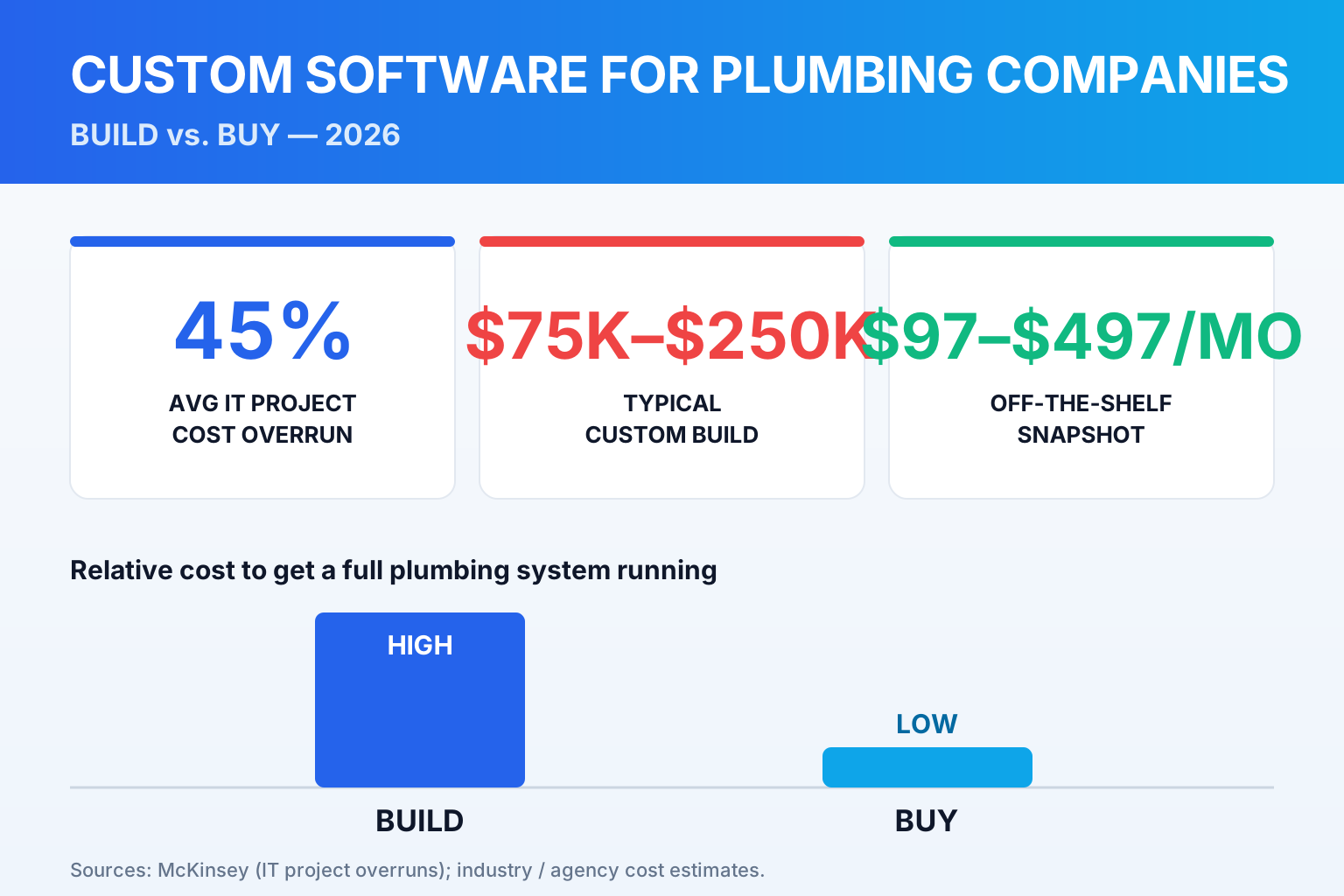
The gap between the two paths is not close. A custom software build for a small-to-midsize business typically runs $75,000–$250,000, and US-based projects are frequently quoted $100,000–$400,000 depending on scope (Artezio). Those are agency estimates, not a studied benchmark — but they’re directionally consistent across the industry, and they’re only the build number. The part owners miss is the recurring load: senior US developers bill $120–$200 an hour, and ongoing QA, hosting, and maintenance add roughly 30–40% of the build price every single year (doit.software). A $150,000 build isn’t a $150,000 decision. It’s $150,000 now and $45,000–$60,000 a year, forever, to keep it from rotting.
Compare that to buying. A done-for-you plumbing system runs on a monthly plan — in the ballpark of $97 to $497 a month depending on the number of locations and whether you’re reselling — with the heavy lifting (workflows, dispatch logic, AI answering, review automation) already built and maintained for you. See the current snapshot pricing for the exact tiers. The difference isn’t 10% or 20%. A shop can run a fully-automated operation for a year on what a custom build costs in a single afternoon of developer time.
Buy (off-the-shelf snapshot) vs. build (custom software)
| Plan | Buy — Off-the-shelf snapshot recommended | Build — Custom software |
|---|---|---|
| Price | ≈ $97–$497 / mo | $75K–$250K+ build |
| Feature 1 | Live in days — workflows already built | 3–12+ months before anything ships |
| Feature 2 | Vendor maintains, updates, and secures it | You own maintenance: +30–40% of build/yr |
| Feature 3 | Proven across thousands of contractors | Unproven until real jobs run through it |
| Feature 4 | Predictable monthly cost, cancel anytime | Large IT projects avg 45% over budget |
| Feature 5 | Covers ~90% of a plumbing shop's needs | Fits your shop exactly — if it ships |
| Feature 6 | You configure; you don't debug | Every bug and outage is your problem |
| See snapshot pricing | When building makes sense |
Cost bands are typical industry/agency estimates. Sources: Artezio, doit.software, McKinsey.
The real risk of building from scratch
Cost is only half the story. The other half is the odds the project even works. This is where the data on custom software gets genuinely sobering, and every plumbing owner weighing a build should sit with it.
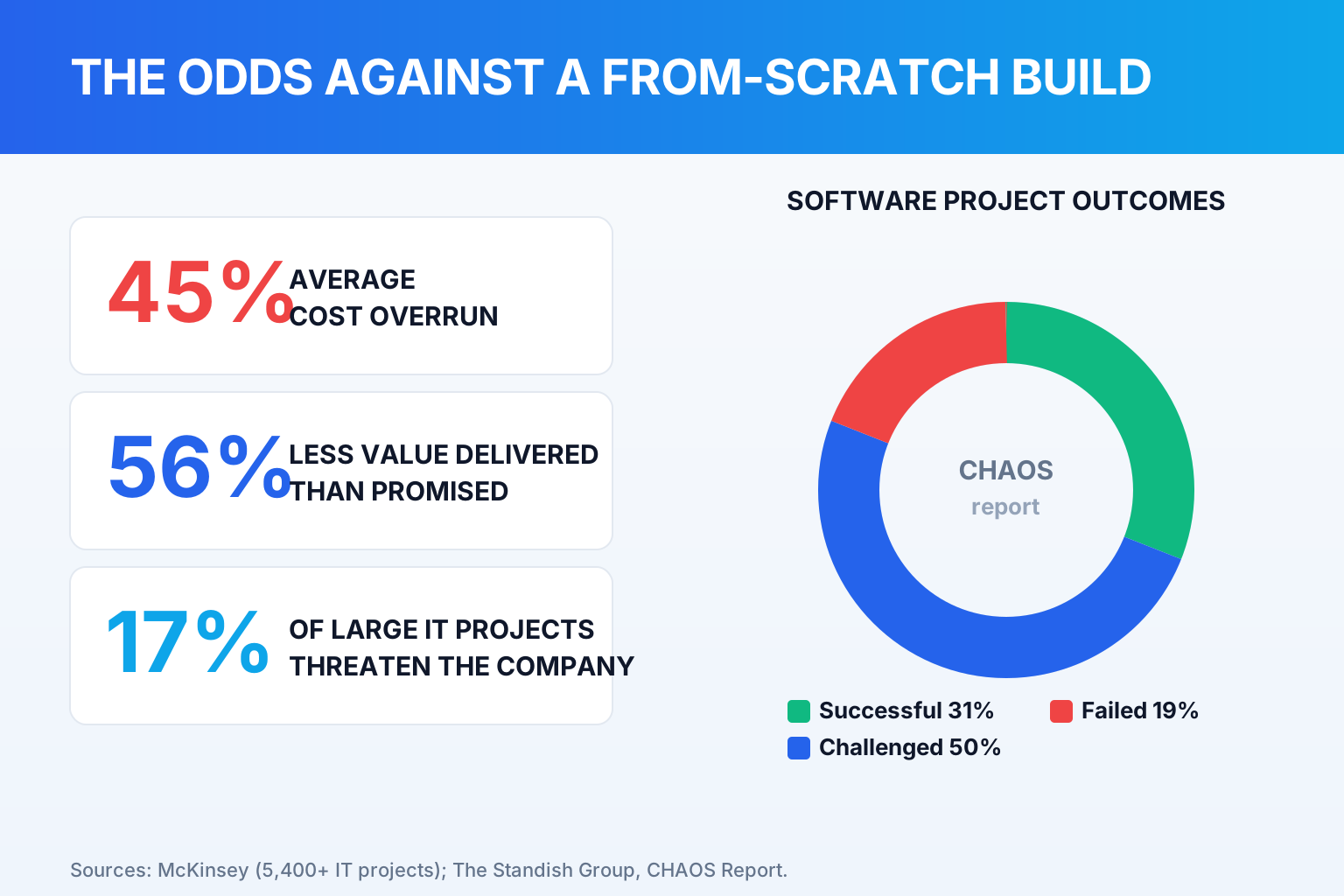
The landmark study here is McKinsey’s analysis, with the University of Oxford, of more than 5,400 large IT projects. On average, those projects ran 45% over budget and 7% over schedule while delivering 56% less value than predicted — and 17% of large IT projects went so badly they threatened the very existence of the company that commissioned them (McKinsey). Those are enterprise projects, but the pattern scales down: the bigger and more from-scratch the build, the worse the odds.
How large IT projects perform against plan, on average (% over budget, % over schedule, % less value than promised). Source: McKinsey & Company / University of Oxford, study of 5,400+ IT projects.
The Standish Group’s long-running CHAOS research tells the same story from a different angle. Across thousands of software projects, only about 31% succeed outright. Roughly 50% are “challenged” — delivered late, over budget, or with less than promised — and 19% fail completely (Standish Group). Read that again as a plumbing owner: if you commission a from-scratch build, the base rate says there’s a two-in-three chance it comes in late, over budget, short of the spec, or dead in the water.
Software project outcomes: successful vs. challenged (late/over budget/under-delivered) vs. failed. Source: The Standish Group, CHAOS Report.
Buying doesn’t eliminate risk, but it moves it. When you buy a proven system, the “does this even work” risk was absorbed by the thousands of contractors who ran on it before you. When you build, you’re the one absorbing it — with your cash and your calendar.
What off-the-shelf already covers for a plumbing shop
Before you can decide you’ve outgrown packaged software, you have to be honest about how much a modern pre-built system already does. For a plumbing operation, an off-the-shelf snapshot typically handles the entire lead-to-review lifecycle:
- 24/7 answering and emergency dispatch — an after-hours AI receptionist picks up the 2 AM burst-pipe call, qualifies it, and routes the on-call tech.
- Online booking and scheduling — homeowners self-schedule; the system confirms and reminds. (See online booking for plumbers.)
- CRM and pipeline — every lead, job, and customer in one place, with the workflows already wired.
- Two-way SMS and photo quoting — quotes and approvals move by text, with consent handled correctly.
- Review and reputation automation — a request fires after every completed job.
- Reporting on the numbers that matter — the KPIs that predict growth, tracked without a spreadsheet.
That’s not a stripped-down starter kit — it’s the operational core of a plumbing business, maintained and updated for you. The average small business already juggles 42 different SaaS apps (Statista), and across all company sizes the average hit 106 apps in 2024 (BetterCloud). A consolidated snapshot’s biggest quiet win is collapsing five or six of those disconnected tools into one system that actually talks to itself — which is the exact “make our tools connect” problem most owners are really trying to solve when they say “custom software.”
Sources: Grand View Research, Statista, IBISWorld, Standish Group.
When custom software actually pays off
Custom development isn’t wrong — it’s situational. There are real cases where a plumbing company should build, and they share a common shape: a requirement that is genuinely unique to your business, drives real revenue or cost savings, and cannot be configured into a packaged tool. Here are the signals that you’ve actually reached that point:
If you nodded at three or more of those, custom is worth pricing out. If you didn’t, what you have is a configuration-and-integration problem — solvable for a couple hundred dollars a month, not a couple hundred thousand up front. And even when a build is justified, it’s rarely the whole system. The winning move is almost always to buy the 90% that’s already solved and build only the unique 10% on top.
The ROI is in the software, not the source code
Here’s the reframe that saves plumbing owners the most money: the returns everyone associates with “custom software” almost never come from the code being custom. They come from running on good software at all.
The evidence is strong. In a Forrester Total Economic Impact study (commissioned by Salesforce, so weigh it accordingly), a composite field-service organization saw a 195% ROI over three years, with first-time fix rates climbing from 70% to 95% and technician no-show rates falling from 10–15% down to 3% (Salesforce/Forrester). Those gains — more jobs closed on the first visit, fewer missed appointments, faster dispatch — are the return. And every one of them is available to a shop that bought its system. You don’t need to own the source code to book the same jobs; you need the workflow running.
That’s the whole case for buy-first in one line: you can capture the ROI of software without paying the cost and risk of building it. The custom build only makes sense once you’ve already captured that baseline and hit a specific wall that packaged tools genuinely can’t clear.
The pragmatic path: buy first, then extend
For nearly every plumbing company, the right sequence looks like this:
- Buy the proven system. Deploy a done-for-you snapshot that covers booking, dispatch, after-hours answering, follow-up, and reviews. You’re live in days, not quarters, and you start capturing the software ROI immediately. This is also the fastest way to migrate off a pile of disconnected tools.
- Extend only what’s unique. When you hit a genuine wall — a portal, a proprietary calculator, a stubborn integration — solve that specific piece with targeted GHL development or a focused custom module. You’re building the unique 10%, not rebuilding the 90% that already works.
- Go fully custom only at scale. If you reach multi-location volume with requirements no platform can hold, then a dedicated custom software build can pay off — and even then, it’s usually an extension of your proven system, not a rip-and-replace.
This staged path gives you the fit of custom where it matters and the speed, cost, and safety of off-the-shelf everywhere else. It’s how a smart shop gets 100% of the benefit while exposing itself to a fraction of the risk.
Frequently asked questions
Should a plumbing company build custom software or buy off-the-shelf?
For the large majority of plumbing companies, buy. A pre-built system already handles booking, dispatch, after-hours answering, invoicing hooks, and reviews — roughly 90% of a shop's needs — for a monthly fee, with the vendor maintaining and securing it. Custom software makes sense only when you have specific, revenue-driving requirements no packaged tool can meet and the volume to amortize a six-figure build. Even then, the smart move is to buy the proven core and build only the unique 10% on top.
How much does custom software cost for a plumbing business?
Typical custom builds run $75,000–$250,000, and US projects are frequently quoted $100,000–$400,000 depending on scope (industry/agency estimates). That's just the build: senior US developers bill $120–$200/hour, and ongoing maintenance, hosting, and QA add roughly 30–40% of the build price every year. By comparison, a done-for-you plumbing snapshot runs on a monthly plan in the ballpark of $97–$497, with the workflows already built and maintained for you.
Why do so many custom software projects fail?
Because building software from scratch is genuinely hard and the base rates are poor. McKinsey's study of 5,400+ large IT projects found they run 45% over budget and deliver 56% less value than predicted on average, and the Standish Group's CHAOS research finds only about 31% of software projects fully succeed while 50% are challenged and 19% fail. The bigger and more from-scratch the build, the worse the odds — which is exactly why buying a proven system, where that risk was already absorbed by thousands of prior users, is safer for most shops.
When is custom software actually worth it for a plumbing company?
When you have a requirement that's genuinely unique to your business, drives real revenue or savings, and can't be configured into a packaged tool — for example proprietary pricing/estimating logic, a customer or technician portal with warranty and membership features, multi-location or franchise dispatch, or a stubborn integration with accounting or supplier systems. And when you have the truck and job volume to pay back a six-figure investment. If you meet three or more of those, price a build. If not, you likely have a configuration-and-integration problem that a bought system solves far more cheaply.
Can I start with an off-the-shelf system and add custom features later?
Yes — that's the recommended path. Deploy a proven snapshot to cover the 90% that's already solved and start capturing the ROI immediately, then extend only the pieces that are truly unique to your shop with targeted GoHighLevel development or a focused custom module. You get the fit of custom where it matters and the speed, cost, and safety of off-the-shelf everywhere else, without rebuilding solved problems.
Isn't the ROI the reason to build custom?
The ROI comes from running on good software at all, not from the code being custom. Field-service platforms have driven a 195% three-year ROI and lifted first-time fix rates from 70% to 95% in a Forrester study (commissioned by Salesforce, so weigh it accordingly) — and a shop that buys its system captures those same gains without paying to build. Custom development is justified by a specific unmet requirement, not by chasing an ROI you can already get off the shelf.
About the author
Yvonne Castellanos is Snapshot Strategist and Agency Partner Success lead for Plumbing Snapshot for GHL, based in Charlotte, NC. She has onboarded plumbing operators from solo owner-operators to regional multi-truck outfits, and spends her days on the boring money — the systems, integrations, and automations that prove ROI in the first 30 days. She’s the person owners call when they’re deciding whether to buy, extend, or build, and she writes case-grounded playbooks that put the math ahead of the hype.
Related reading
- How to Migrate a Plumbing Business to GoHighLevel — the buy-first path, step by step.
- GoHighLevel for Plumbers: The Complete Setup Guide — what a pre-built system actually includes.
- Plumbing Business KPIs — the numbers your software should be tracking.
- Online Booking for Plumbers — one solved workflow you never need to build.
- Custom Software for Plumbers — when and how to extend beyond off-the-shelf.