
It is 2:15 on a Tuesday and your best tech just texted you a photo of a 14-year-old water heater, rusting at the base, in a garage with a finished room above it. He quoted $340 to replace the T&P valve and left. The homeowner said they would think about it. He is already driving to the next call, proud he gave them an honest, cheap fix.
That water heater is going to fail. When it does, the homeowner calls whoever answers, and the $2,800 tankless job plus the drywall repair goes to another shop. Your guy did nothing wrong as a plumber. He just lost you a job as a salesman and does not know it happened.
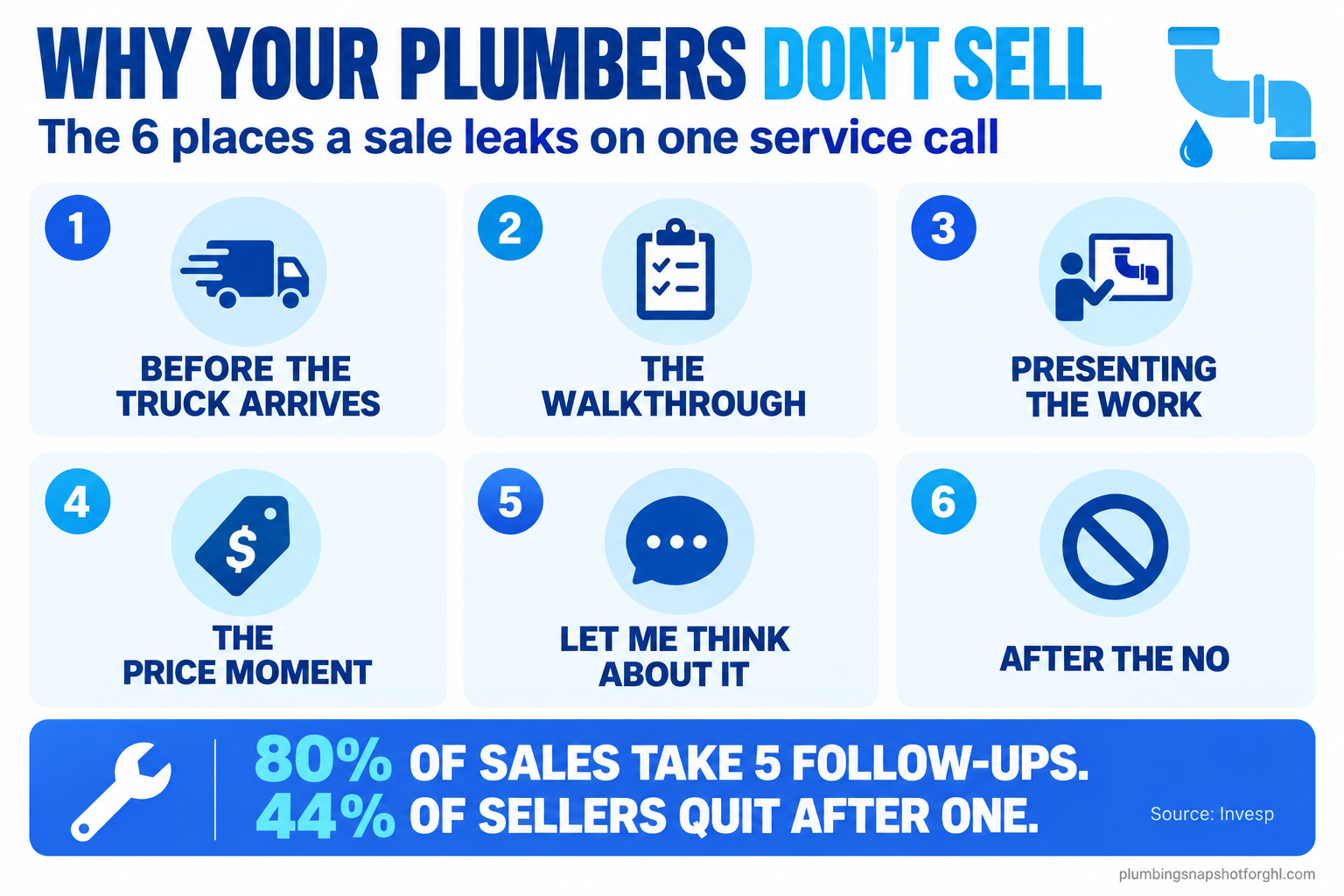
Most plumbers do not sell because nobody ever built a system that does the selling for them. They were trained to diagnose and repair, not to present options, hold a price without flinching, or follow up on an estimate that went quiet. That is not a character flaw in your crew. It is a gap in your operation, and gaps get closed with scripts, defaults, and automation, not a pep talk about being aggressive. This guide walks the six places a sale leaks on one call, hands you the copy to plug each one, and shows how it changes by shop size.
In this guide
- Your techs aren’t bad at the job, they’re bad at the close
- What a weak close actually costs you
- The six places the sale leaks on one call
- Steal this: the exact scripts and texts
- How this changes by shop size
- Objections, answered
- Frequently asked questions
- About the author
Your techs aren’t bad at the job, they’re bad at the close
Ask a plumber to find a slab leak and they will chase it down with a listening disc and a pressure test. Ask the same plumber to present a $6,400 repipe as the smart option over a $900 patch, and a lot of them freeze. They lower their voice, lead with the cheapest thing, and let the customer talk themselves out of the work.
This is normal. The trade selects for people who like solving physical problems, not sitting at a kitchen table talking money. A tech who is uncomfortable with the close is not a bad hire, he is an untrained one, and the fix is not a sales seminar. It is a set of defaults the shop builds so he does not have to improvise the hardest part of the job on the spot.
When operators tell me “my guys just aren’t closers,” what they almost always mean is this: no price book, so every quote is made up on the spot. No options, so the tech offers one number. No photos, so the customer cannot see the problem. No follow-up, so every “let me think about it” is a dead end. Give a mediocre closer those four things and the close rate climbs without anyone getting pushy.
What a weak close actually costs you
The cost is not only the jobs you lose, it is the jobs you win at a fraction of what they were worth, every truck, every day.
Run the math on one truck. A tech books four jobs a day at an average ticket of $420. That is $1,680. Give him a good-better-best price book and a photo quote, and the average ticket moves to $620 because he presents the bigger repair, not just the smallest patch. Same four jobs, now $2,480 a day. That is roughly $200,000 a year, on one truck, with zero extra leads. You already paid for those calls; you are leaving the back half of each one on the table.
Then there is the water heater and repipe work that walks out as a “think about it.” Those jobs are real and common. Water damage and freezing makes up about 27.6% of all homeowners insurance claims and averages $13,954 per claim (Insurance Information Institute). The homeowner with the rusting tank is a flood waiting to happen, and the shop that frames that clearly, with a photo and options, gets the job before the failure instead of after.
The tech’s time is not free either. A licensed plumber earns a median wage of about $63,800 a year and the trade is tight (U.S. Bureau of Labor Statistics), so every truck roll that ends in a quiet “no” burns an expensive hour for nothing.
The six places the sale leaks on one call
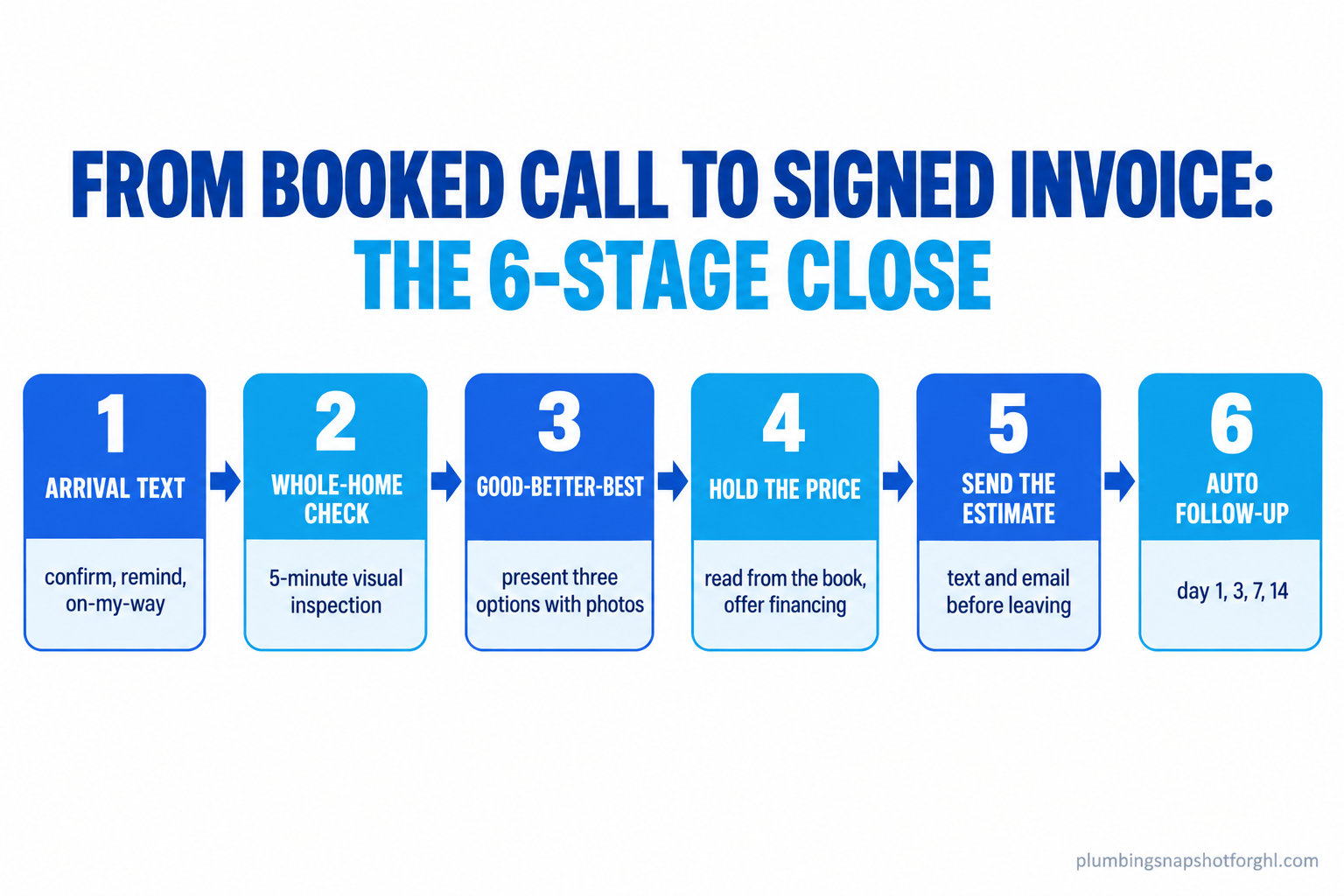
Walk a single call from the phone ringing to the paid invoice and you can watch the sale leak at six specific points.
Stage 1: Before the truck even arrives
The close starts before the tech knocks. A homeowner who booked three hours ago and heard nothing is still shopping, still reading reviews, and half-expecting a no-show. By the time your tech arrives, trust is low and the customer is braced to say no.
How it breaks: no confirmation, no arrival window, no “here is who is coming,” so the customer still feels like a ticket.
What plugs it: an automatic confirmation text at booking, a reminder the morning of, and an “on my way” text with the tech’s name and photo when he leaves the prior job. This is the same speed-to-lead discipline that wins the first call, applied to the hours before arrival. A customer who gets those three has decided you are the real deal before your guy says a word.
Stage 2: The walkthrough and diagnosis
Most techs diagnose the symptom the customer called about and stop. The drain is slow, so they snake it. The faucet drips, so they swap the cartridge. They never look at the water heater, the corroded shutoffs, or the pan with no drain. They fix the $180 thing and miss the $4,000 thing standing right next to it.
How it breaks: a narrow diagnosis trained by years of “just fix what they called about.”
What plugs it: a standard whole-home visual check on every call, five minutes, same list every time. Water heater age, supply lines, main shutoff, angle stops, signs of past leaks. The tech is not upselling, he is doing a real inspection, and the photos he takes become the quote in the next stage.
Stage 3: Presenting the work, where one price loses
This is the biggest skill leak, and it is pure structure. A tech who offers one number forces a yes-or-no decision, and “no” is the easy answer. A tech who offers three options changes the question from “should I do this?” to “which one is right for me?”
How it breaks: no flat-rate price book, so the tech invents a single number, usually low, because he is guessing and does not want to seem expensive.
What plugs it: a good-better-best price book the tech reads from. Good is the repair. Better is the repair plus the obvious adjacent fix. Best is the full replacement. Most customers pick the middle, which is almost always bigger than the single number a nervous tech would have blurted out. It also kills the gap where two techs quote the same job hundreds apart.
Stage 4: The price moment
Watch a tech who has no price book say the number. He drops his eyes, rushes it, apologizes, offers to knock something off. The customer reads all of that as “even he thinks this is too much.”
How it breaks: the tech owns the price personally, so he flinches, and he has no financing to offer, so a big number feels impossible.
What plugs it: the price comes from the book, so the tech is just the messenger. And every quote over a threshold, say $1,500, comes with a monthly payment option. “The repipe is $6,400, or about $142 a month” is a different conversation than “$6,400.” Offering payment plans is often the difference between a signed job and a lost one.
Stage 5: “Let me think about it”
The customer says they need to think. Your tech says “sure, no problem,” packs up, and leaves nothing behind. Now the whole sale depends on them remembering to call you back, which they will not, because the pipe is not leaking today.
How it breaks: nothing is captured and nothing is scheduled. The estimate lives only in the tech’s head and a paper carbon.
What plugs it: the written estimate goes to the customer by text and email before the tech leaves the driveway, photos attached, options laid out, and the next follow-up is scheduled automatically. They leave with a real document, not a vague memory.
Stage 6: After the no, where most of the money dies
This is the single largest leak in the whole operation, and it is almost entirely automatable. An unsold estimate with no follow-up is a lost job, full stop. But most shops follow up once, if at all, then give up.
Share of salespeople who stop following up after each attempt, while about 80% of sales are not made until the fifth follow-up. Source: Invesp.
Read that chart next to the headline: 80% of sales happen on or after the fifth follow-up, but 92% of sellers have already quit by then. The shop that keeps following up, politely and automatically, wins jobs its competitors abandoned. That is what an automated estimate follow-up sequence does, hitting day 1, 3, 7, and 14 with no tech remembering anything.
Steal this: the exact scripts and texts
Here is the copy. Load it, change the shop name, and your close rate moves without one conversation about “being more of a closer.” These are texts a real person would send, not marketing blasts.
That last message does double duty. It builds your review pipeline and routes any unhappy customer back to you privately instead of to a public one-star. Send it the same day the job closes, automatically.
How this changes by shop size
The leaks are the same at every size. Which one is bleeding you most, and what to fix first, depends on your setup.
Solo owner-operator (you are the tech). The skill gap is yours, and you are probably underselling because you hate the money talk and you are exhausted. Your best fix is the follow-up automation, not a script. You cannot chase every unsold estimate by hand while running calls all day, so the day-1 through day-14 cadence on autopilot recovers jobs you would otherwise never touch. Build the price book second so you stop lowballing yourself.
The 3-truck shop. Now the problem is consistency. Your techs quote the same job three ways, your best guy closes at 55% and your newest at 20%, and you have no idea which estimates sit unsold because it all lives in trucks and texts. Fix it with a shared good-better-best price book so every tech quotes the same, plus a central follow-up system so nothing falls through a crack. This is the size where owners start shopping field service software and find the expensive platforms are built for much bigger shops.
The 10-to-15-truck shop. At this scale the money is in the numbers you cannot see: every estimate tracked, close rate by tech reported weekly, average ticket trended, follow-up running automatically across hundreds of open quotes a month. A single point of close-rate improvement across a fleet this size is real money. The failure mode here is not a shy tech, it is a leaky pipeline nobody is measuring.
Objections, answered
“My guys are plumbers, not salesmen. I don’t want pushy closers.” Good, because none of this is pressure. A price book, a photo, a payment option, and a polite follow-up text are not hard-sell tactics; they give the customer more to work with. Your techs will feel more comfortable, not less, because the number comes from the book instead of their gut.
“Won’t the automatic follow-up texts annoy people?” Only if they are robotic and relentless. The cadence above is four human messages over two weeks, each offering help rather than demanding a decision, and each lets the customer reply “not interested” and stop. You must have consent to text and honor opt-outs, which is covered by TCPA-compliant setup, but done right it reads as good service, not spam.
“I already pay for ServiceTitan or Housecall Pro or Jobber. Isn’t this built in?” Partly, and that is the trap. These platforms can hold a price book and send a text, but the closing system itself, the good-better-best structure, the photo-quote flow, the follow-up cadence, the financing presentation, has to be built and maintained by you. ServiceTitan does not even publish a price and is aimed at larger operations (ServiceTitan pricing). Housecall Pro’s useful tier runs about $129 a month billed annually plus $35 per extra user (Housecall Pro pricing), and Jobber stacks paid add-ons on top (Jobber pricing). Owning the software is not the same as owning the system that closes jobs.
“Do I need to be technical to run this?” No. In a done-for-you setup the price book, the texts, the follow-up timing, and the review flow are already built and connected. You approve the copy and the prices, your techs read from the book, and the automation handles the rest. If you can send a text and approve an estimate, you can run it.
Frequently asked questions
Why don't my plumbers sell more on each call?
They were trained to diagnose and repair, not to present options, hold a price, or follow up, and most shops never give them the structure. A good-better-best price book, photos on every quote, a financing option, and an automatic follow-up cadence close the gap without anyone turning into a pushy salesman.
What is a good average ticket for a residential plumbing call?
It varies by market, but the lever that matters most is whether your techs present options instead of one low number. Shops that move from single-price quoting to a good-better-best price book with photos routinely see their average ticket climb, because customers pick the middle option and the real repairs stop walking out as 'think about it.'
How many times should I follow up on an unsold plumbing estimate?
At least four or five times over about two weeks. Roughly 80% of sales are not made until the fifth follow-up, yet most sellers quit after one, per Invesp. An automated cadence on day 1, 3, 7, and 14 recovers jobs your competitors have already given up on.
Should plumbers offer financing on big jobs?
Yes, on anything over roughly $1,500. Presenting a repipe as '$6,400, or about $142 a month' changes the decision from impossible to manageable for a lot of homeowners, and is often the difference between a signed job and a lost one.
Is this just upselling customers things they don't need?
No. The whole-home visual check finds real problems, like a rusting water heater above a finished room, and the options let the customer choose how to handle them. You are giving more information and more choices, not inventing work. Framing a genuine future failure honestly, with a photo, is good service.
If your phone rings all day and the money still is not showing up, the close is usually where it is going. Fix the six leaks, let the system do the parts your techs hate, and the calls you already pay for turn into the jobs they were worth. Want the numbers first? See what the software actually costs and our pricing, then wire up the close.
About the author
Hector Salinas is GHL Automation Lead at Plumbing Snapshot. He spent nine years dispatching for a 12-truck plumbing operation before building GoHighLevel systems full time, and he has watched more good plumbers lose jobs at the kitchen table than on the job itself. He writes the way he would brief a new service manager: plainly, with the revenue math attached.