

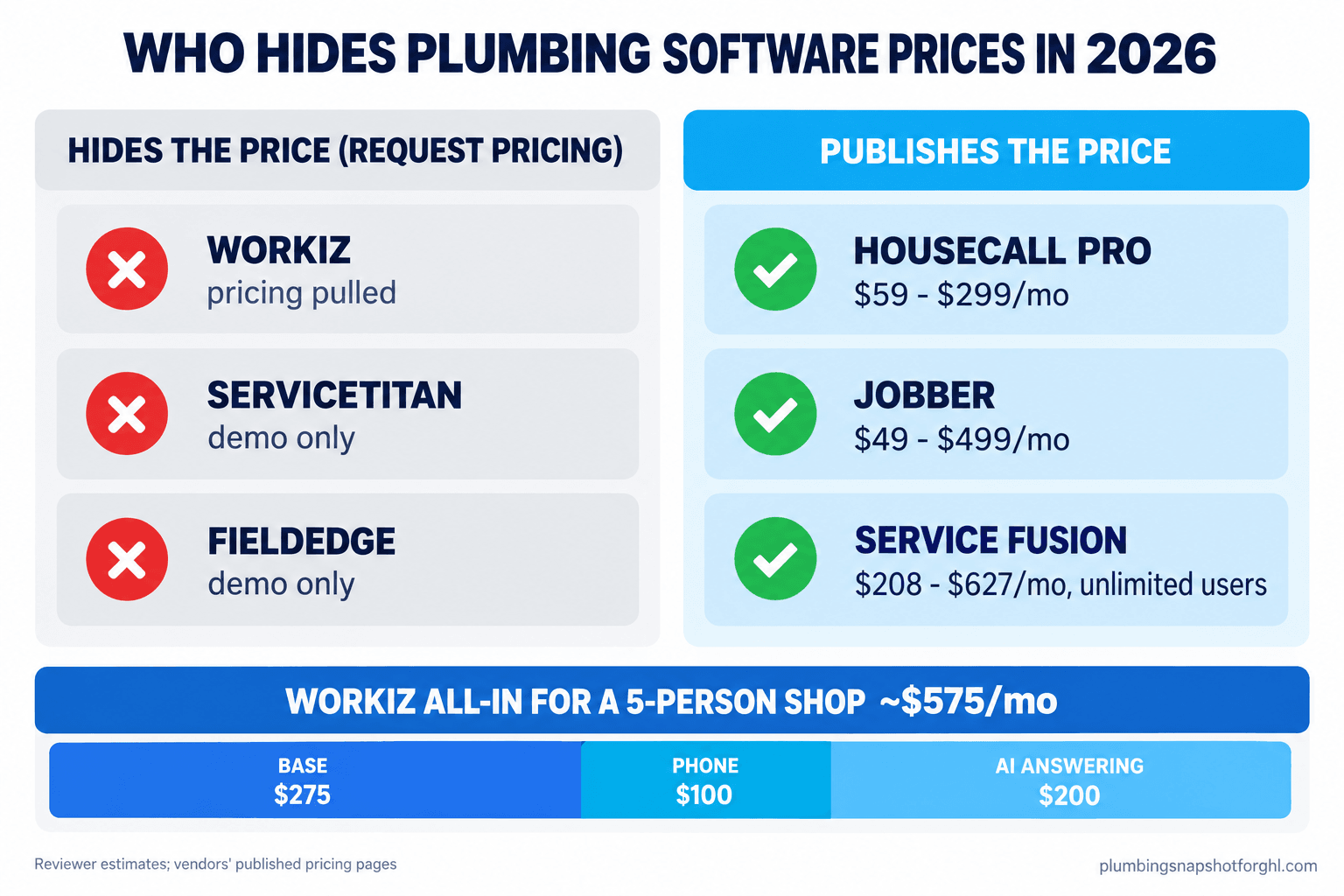
Workiz used to print its plan prices on the page. In 2026 those numbers are gone, replaced by “Request pricing” buttons, and trackers have caught the old pricing URL throwing errors. Based on recent reviewer reports, a Workiz base plan runs roughly $225 to $325 a month for about 5 users, but the sticker is half the bill: the phone system and the Genius Answering AI receptionist are separate paid add-ons, so a real 5-person shop lands closer to $500 to $575 a month all in. Three competitors, Housecall Pro, Jobber, and Service Fusion, still publish every number, and they are usually cheaper. Here is the full teardown: the add-ons nobody mentions, what three shop sizes pay, and how to force a real price out of any rep in one email.
In this guide
- The quote you never got
- What hiding the price actually costs you
- What does Workiz actually cost in 2026?
- The add-ons that aren’t in the sticker price
- What Workiz costs at three shop sizes
- The alternatives that still publish a price
- How a software switch actually goes wrong
- Staying legal when you automate the phone and the texts
- Steal these: the questions that force a real price out of any rep
- Objections
- Frequently asked questions
- About the author
The quote you never got
It is a Thursday night and you finally sit down to price the field service software your buddy keeps pushing. You open the Workiz site, click pricing, and there is no price. Three plans, three gray “Request pricing” buttons, a form that wants your name, your phone, your shop size, and your revenue. You fill it out, and what you get is a rep who texts you for two weeks and a demo booked before anyone says a dollar figure out loud.
A year or two ago Workiz posted real tiered prices on that same page. They took them down, and a company pulls its prices when the number is high enough that seeing it cold would cost the lead. So let’s put the number back on the page, from reviewer reports and the parts of Workiz’s own documentation that still say the quiet part.
What hiding the price actually costs you
Start with the trade you are in. The Bureau of Labor Statistics puts the plumbing median wage at $62,970 a year as of May 2024, projects 4% job growth through 2034, and expects about 44,000 openings a year (BLS Occupational Outlook Handbook). Demand is steady, labor is tight, and your margin is made or lost on how cleanly you run the shop. Software is supposed to protect that margin, not quietly eat it.
The demo wall works against that. When you cannot see a price, you cannot compare on price, so the rep anchors you on features and quotes a package shaped to what they think you will pay. The vendors that print the number hand that lever back to you.
What does Workiz actually cost in 2026?
The caveat goes on the front: every figure below is a reviewer estimate from 2026 pricing trackers, not a quote, because the pricing page now lists plans behind “Request pricing” buttons with no dollar amounts (Workiz pricing page). The reported lay of the land:
- Base plans run about $225 to $325 a month. Trackers list a Standard tier near $225 to $275 and a Pro tier near $325, each including roughly 5 users (Toolduppro, ServiceAgent).
- Extra users cost about $55 to $65 each per month past the included 5 (Toolduppro).
- A higher “Ultimate” tier is custom priced, which is another way of saying request pricing again (Capterra: Workiz).
So before a single add-on, a small shop is reportedly looking at $225 to $325 a month, except you had to fill out a form to confirm it. And the base plan is not what surprises people on the invoice. The add-ons are.
The add-ons that aren’t in the sticker price
This is where the real bill hides, because the two features you bought the software for, answering the phone and texting the customer, cost extra.
The phone system is a separate add-on, around $100 a month on top of your base plan, and you need it for the call tracking and click-to-call (Toolduppro).
Genius Answering, the AI receptionist, is a separate premium add-on. That is not a third-party read: Workiz’s own help center introduces it as a “premium add-on,” sold separately and requiring a phone plan (Workiz help center). Reviewers report it near $200 a month (Toolduppro). The AI that answers the 2 AM burst-pipe call is the whole point of buying this, and it is not in the number the rep leads with. Text credits and card processing are metered too, on no plan tile.
Stack the common pieces for a 5-person shop and the add-ons roughly double the base plan:
Reported monthly Workiz cost components for a 5-user plumbing shop (reviewer estimates; Workiz does not publish these). Source: Toolduppro Workiz pricing guide and Workiz help center.
Add it up and that 5-person shop is reportedly near $575 a month before SMS credits and card fees (Toolduppro). The base plan you were quoted was less than half of it.
What Workiz costs at three shop sizes
The answer changes with your truck count, so run it three ways, using the reported figures above as a planning range, not a quote.
Solo owner-operator, 1 to 2 users. You still want the phone answered when you are under a sink, so you pay for base plus phone plus Genius Answering from day one: roughly $500 to $575 a month. That is a lot for one truck, and it is where the published entry tiers (Housecall Pro at $59, Jobber at $49) pull furthest ahead.
Growing shop, 5 users. You fit inside the included seats, so no per-user surcharge yet. All-in lands near $575 a month, about $6,900 a year (Toolduppro). This is where Workiz is most competitive, and where you hold it against Service Fusion’s flat unlimited-user price before your sixth hire.
Multi-truck, 12 to 15 users. Now the per-seat fee bites. Ten extra users at roughly $60 each adds about $600 a month on top of the base and add-ons, pushing you past $1,100 a month. At that headcount, per-seat pricing is the enemy.
Per-user pricing is friendly when you are small and punishing when you grow, the exact trade we broke down in per-tech versus unlimited-user plumbing software pricing.
The alternatives that still publish a price
No guessing with these three. Every number is on their pages, no form required, and the full all-vendor breakdown is in what plumbing software actually costs in 2026.
| Software | Published entry price | Top published tier | User model | Shows price without a demo? |
|---|---|---|---|---|
| Workiz | Not published (est. ~$225/mo) | “Ultimate” custom | Per plan, ~5 users + ~$60/user | No (pulled) |
| Housecall Pro | $59/mo (Basic, annual) | $299/mo (Max, up to 8) | Per plan + $35/extra user | Yes |
| Jobber | $49/mo (Core, 1 user) | $499/mo (Plus, 15 users) | Per plan + $29/extra user | Yes |
| Service Fusion | $208/mo (Starter, annual) | $533/mo (Pro, annual) | Unlimited users | Yes |
| ServiceTitan | Not published (est. $245-$500/tech) | Custom | Per technician | No |
| FieldEdge | Not published | Custom | Per user | No |
Sources: Housecall Pro, Jobber, Service Fusion, ServiceTitan third-party estimate via G2. Workiz and FieldEdge do not publish base rates.
Housecall Pro ($59 to $299 a month, extra seats $35) is the friendliest entry point for a solo or two-truck shop (Housecall Pro).
Jobber ($49 to $499, extra seats $29) layers its AI Receptionist, Marketing Suite, and Pipeline on as paid add-ons, so price it the way you price Workiz: base plus the pieces you need (Jobber).
Service Fusion ($208 to $533 a month billed annually) is built for the shop that plans to grow, because every tier carries unlimited users with no contract (Service Fusion). A 15-truck shop pays what a 3-truck shop pays, which is where the flat model wins.
ServiceTitan and FieldEdge join Workiz behind the demo wall. ServiceTitan is estimated at $245 to $500 per technician per month plus a $5,000 to $50,000 implementation fee, and has told the BBB it is not optimized for shops with three or fewer technicians, which we tore apart in what a small plumbing shop actually pays for ServiceTitan (G2: ServiceTitan). FieldEdge will not show a number at all.
Line up what a 5-technician shop pays per month, add-ons included where a vendor needs them for a comparable setup, and the demo-wall tools sit at the top:
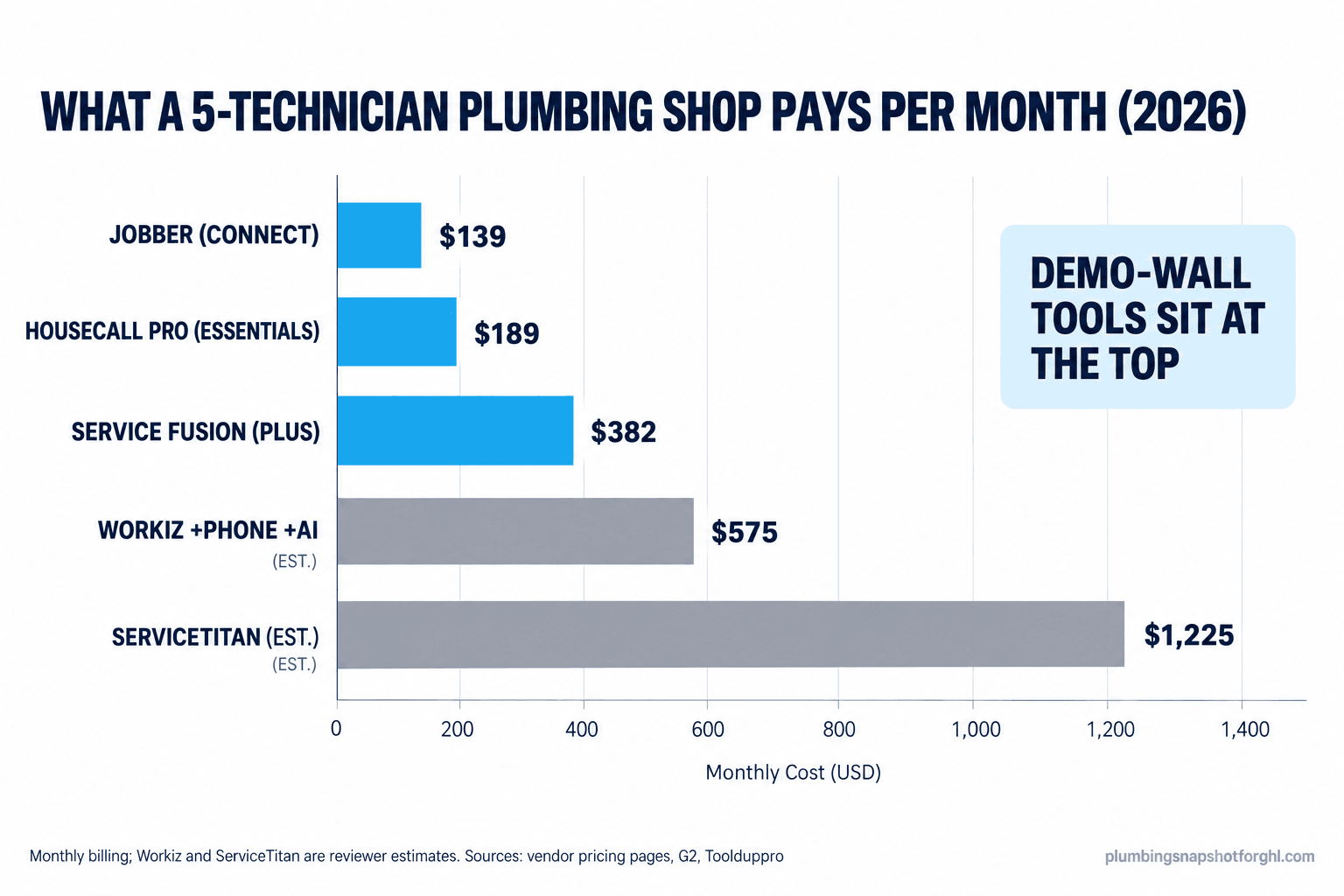
Reported monthly subscription for a 5-technician shop (monthly billing; Workiz and ServiceTitan figures are reviewer estimates since neither publishes a price). Sources: Jobber, Housecall Pro, Service Fusion, Toolduppro (Workiz), G2 (ServiceTitan).
How a software switch actually goes wrong
Picking the tool is the easy part. Here is where shops get hurt, and the fix for each.
Add-on creep eats the savings. You buy the base plan at a fair price, then discover the AI answering, the phone, the booking, and the review requests are each an upcharge, and six months later your “cheap” tool costs more than the one you rejected. The fix: write down the five features you actually need and get each one priced in writing before you sign. A base plan you can afford with add-ons you cannot is a trap.
The data export clause. Your customer list, job history, and photos are the business. Some contracts make them slow or costly to get back out when you leave. The fix: ask in writing, “If I cancel, can I export all customer and job data in a standard format at no charge?” before you migrate anything in. If the answer is vague, that is your answer.
The migration eats a season. Moving years of jobs into a new system during your busy months is how shops lose a week of dispatch to a spreadsheet. The fix: migrate in your slow season and run both systems in parallel for two weeks before you cut over.
SMS deliverability dies on day one. This one blindsides plumbers. Your “tech is on the way” and review-request texts run over the A2P 10DLC system, and if your number is not registered correctly, they silently fail to deliver. You think the feature is on. The customer never got the text. The fix is in the next section, because it is also the law.
Staying legal when you automate the phone and the texts
Every tool here can text your customers, and that is where the compliance line sits. It does not change based on which vendor you pick.
TCPA means you need consent to text. The Telephone Consumer Protection Act governs business texting, and sending marketing or reminder texts without the right prior consent carries real per-message penalties (FCC on the TCPA). A customer handing you their number to book a job is not consent to a marketing blast, so your intake has to capture the opt-in. We walk the exact language in TCPA compliance for plumbing SMS.
A2P 10DLC means your number has to be registered. Carriers route business texts through the A2P 10DLC framework, and campaign registration increasingly has to point at a live privacy policy and terms page on your website (The Campaign Registry). Skip it and your texts get filtered before they reach a customer. Whatever software you choose, that registration is on you. The full checklist lives in the three things that make your plumbing marketing illegal in 2026.
A cheaper tool with SMS set up wrong costs more than a pricier tool set up right, because unsent texts are lost jobs and bad texts are fines.
Steal these: the questions that force a real price out of any rep
When a vendor hides the number, you pull it out with specific questions. Paste this into the “request pricing” form or the first email, and you will have a real budget before the demo, not after it.
Before we book a call, please send the following in writing so I can compare apples to apples:
- The monthly price of each plan, billed monthly and billed annually.
- How many users each plan includes and the cost per additional user.
- Whether the phone system is included or a paid add-on, and its monthly price.
- Whether AI call answering is included or a paid add-on, and its monthly price.
- SMS/text message costs and any card processing percentage.
- Any one-time setup, onboarding, or implementation fee.
- Contract length, and whether I can export all my customer and job data for free if I cancel.
And the script for the call itself, when the rep moves to features before dollars:
“I appreciate the walkthrough, but my rule this quarter is no demo until I have the all-in monthly number in writing, with add-ons. Can you email that first? If it fits the budget, I will happily book 30 minutes.”
The tools that publish, Housecall Pro, Jobber, Service Fusion, you can budget in ten minutes. The ones that hide, you make earn the call.
Objections
“I already pay for Workiz and switching sounds like a nightmare.” Then do not switch blind, but get the all-in number in writing at your next renewal, add-ons included, and hold it against Service Fusion’s unlimited-user price if you are growing. Inside 5 users and happy, the cost may be fine. Adding trucks, the per-seat fee is the thing to watch, and that is a renewal conversation worth having with the real number in hand.
“Isn’t hiding prices and doing demos just normal enterprise sales?” For a 500-truck operation, sure. For a 1 to 15 truck shop, a two-week sales chase to learn a monthly price is a tax on billable time. The vendors that print the number tend to be the ones priced for your size in the first place. The demo wall is aimed at bigger fish than you.
“Do I need to be technical to run any of this?” No. These tools are built for contractors, not IT departments. The part that needs care is not the software, it is the SMS compliance setup, and that is a one-time job. If you would rather not touch it, a done-for-you system hands you the whole thing pre-wired, which is the trade we make.
“What if the cheap tool is missing a feature I need?” Likely on the entry tiers, which is why you price the mid tier plus the add-ons you actually use, not the headline number. A $49 plan that needs $150 of add-ons to match your workflow is really a $199 plan. Price the workflow, not the sticker.
Frequently asked questions
How much does Workiz cost per month in 2026?
Workiz no longer publishes prices. Based on 2026 reviewer reports, base plans run roughly $225 to $325 a month for about 5 users, and a realistic all-in for a 5-person shop, once you add the phone system (about $100) and the Genius Answering AI receptionist (about $200), is near $575 a month before SMS credits and card fees.
Why did Workiz remove its prices?
Workiz once listed tiered dollar prices and has replaced them with 'Request pricing' buttons, and trackers have logged the old pricing URL returning errors. Vendors typically hide prices when the number is high enough that showing it cold would cost them leads, and when a rep can quote a figure shaped to your revenue instead.
Is Workiz's AI answering (Genius Answering) included in the plan?
No. Workiz's own help center describes Genius Answering as a 'premium add-on,' sold separately and requiring a phone plan. For a plumbing shop it is the feature you are most likely buying the software for, and reviewers report it adds around $200 a month on top of the base plan and phone system.
Which plumbing software still publishes its prices?
Housecall Pro ($59 to $299 a month), Jobber ($49 to $499 a month), and Service Fusion ($208 to $627 a month with unlimited users) all list every price publicly with no demo required. ServiceTitan, FieldEdge, and Workiz keep their base rates behind a 'request pricing' wall.
Is Workiz cheaper than ServiceTitan?
Almost certainly. ServiceTitan is estimated at $245 to $500 per technician per month plus a $5,000 to $50,000 implementation fee, so a 5-tech shop can clear $1,200 a month before implementation. Workiz's reported all-in for 5 users is closer to $575. Both hide their prices, and both run pricier than the published-number tools for a small shop, where Housecall Pro Basic ($59) and Jobber Core ($49) are the cheapest published entry points.
About the author
Tyler Brennan is the Compliance and Conversion Editor at Plumbing Snapshot for GHL, where he owns the TCPA, consent, and SMS guidance and pressure-tests every pricing claim against what shops actually pay. He writes the pricing teardowns the demo wall is designed to prevent.