
It is 7:40am. You are halfway under a kitchen sink when the phone buzzes in your back pocket. By the time you wipe your hands and dig it out, it has stopped. You will call back when you finish this job, maybe around 10. By then, the homeowner with the leaking water heater has already booked the next plumber who picked up.
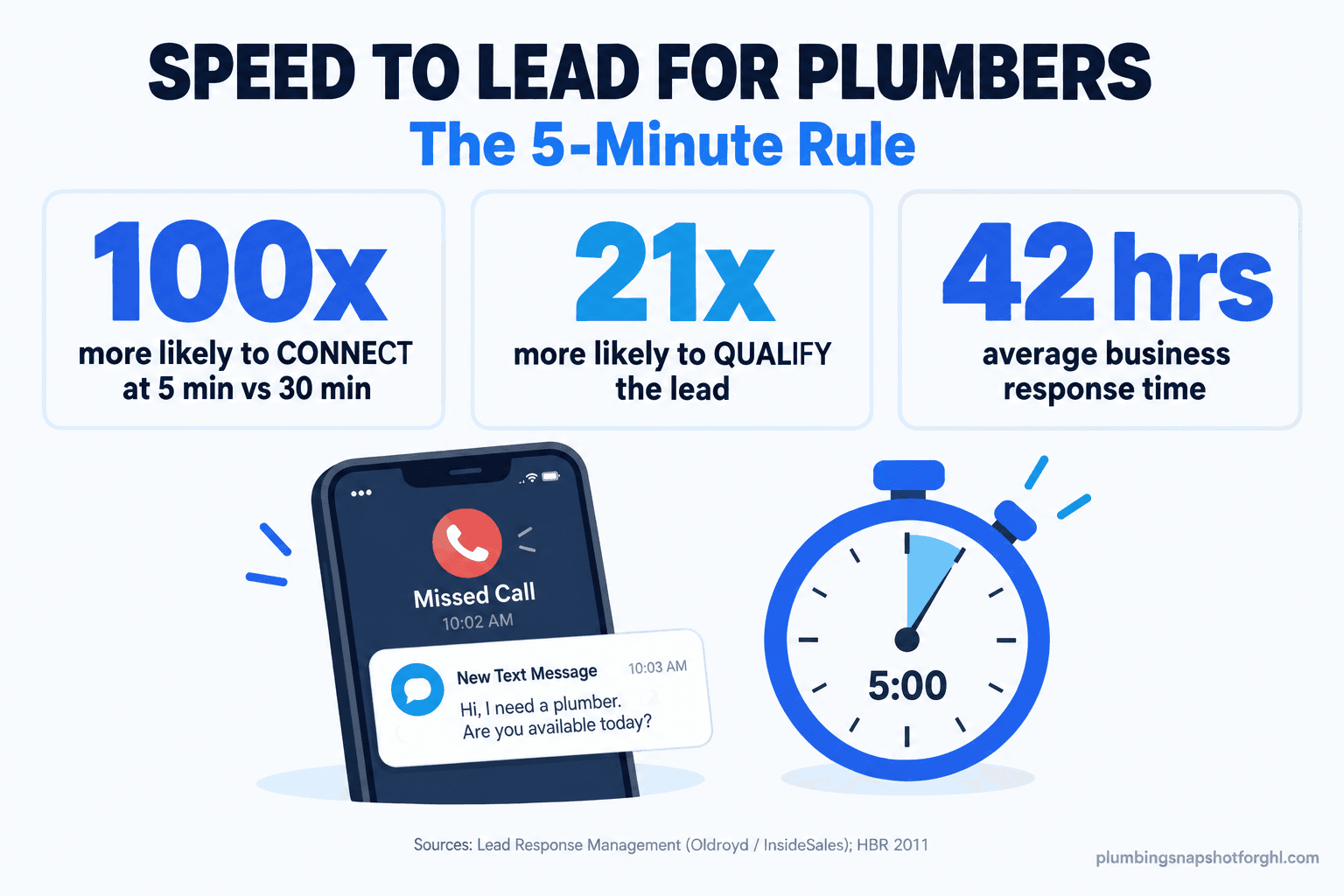
Speed to lead for plumbers is the practice of responding to every new inquiry, a phone call, a web form, a Google ad click, a Facebook message, within minutes instead of hours, because the shop that responds first almost always books the job. The research is remarkably consistent: contacting a lead within five minutes instead of thirty makes you roughly 100 times more likely to connect and 21 times more likely to qualify that lead (Lead Response Management study, Oldroyd / InsideSales). Yet the average company takes 42 hours to respond, and 23% never respond at all (Harvard Business Review). This guide is the exact system that closes that gap, the real copy to use, and how it changes by shop size.
In this guide
- What is speed to lead for plumbers?
- The 5-minute rule: what the research actually says
- What slow response really costs a plumbing shop
- The 6-stage speed-to-lead system
- Steal this: the exact messages and timing
- How speed to lead changes by shop size
- The compliance layer you cannot skip
- Common objections, answered
- Frequently asked questions
- About the author
What is speed to lead for plumbers?
Speed to lead is simply how fast you make real contact with a new inquiry. Not how fast you log it or add it to a spreadsheet, but how fast a human or an automated message actually reaches the homeowner who just raised their hand.
For a plumbing shop, a “lead” is not only a phone call. It is the website form at 11pm, the message button on your Google Business Profile, the Facebook or Instagram DM, the Local Services Ads lead, the text to your shop number. Every one is a person with a wet floor deciding right now who to trust with their house. And they rarely arrive when you are at a desk. They come in while you are elbow deep in a P-trap, driving, or asleep at 2am. That is not a discipline problem, it is a coverage problem, and coverage gets solved with systems, not willpower.
That is what a speed-to-lead system does. It puts an automated first responder on every channel, then hands you a warm conversation instead of a cold callback to chase.
The 5-minute rule: what the research actually says
The “5-minute rule” is not a slogan a software company made up. It comes from the Lead Response Management study, led by Dr. James Oldroyd, which analyzed roughly 15,000 leads and more than 100,000 call attempts. The finding: reaching out within five minutes instead of thirty made a company about 100 times more likely to connect and 21 times more likely to qualify the lead (Lead Response Management / InsideSales). The odds fall off a cliff after five minutes.
Harvard Business Review ran a separate audit of 2,241 U.S. companies and found the same shape. Firms that contacted a lead within an hour were nearly 7 times more likely to reach a decision-maker than those that waited one hour longer, yet the average first-response time was 42 hours and 23% never responded at all (Harvard Business Review).
Now put that next to how plumbing calls get handled. A 411 Locals study of 85 businesses found only 37.8% of inbound calls reach a live person; the rest hit voicemail or ring out (411 Locals). For a trade where the people answering the phone are the people turning wrenches, the real miss rate is usually worse.
The takeaway is blunt. At the moment a homeowner calls, they cannot see your pipe-sweating skill. All they see is who answered. Speed is the first thing you sell.
What slow response really costs a plumbing shop
Run the math on your own board. Say your marketing produces 100 new inquiries in a month. Respond inside five minutes and you might book 30. Let most hit voicemail and get a callback hours later, and the cold-callback booking rate routinely falls by half, because the homeowner already hired someone. That is 15 jobs instead of 30. With an average ticket of a few hundred dollars, and some of those being water heaters or repipes worth thousands, that gap is the difference between a good month and a thin one.
There is a second, slower cost. Every homeowner who got your voicemail and hired someone else now has a plumber. You did not just lose one job, you lost that customer’s next water heater and the neighbors they would have referred. HubSpot research found 60% of customers define an immediate response as 10 minutes or less (HubSpot). A four-hour callback is not good service, it is a lost job.
The 6-stage speed-to-lead system
A real speed-to-lead system is not one trick, it is six stages working together, from the second a lead lands to the day they book. For each, here is how to set it up and the way it breaks.
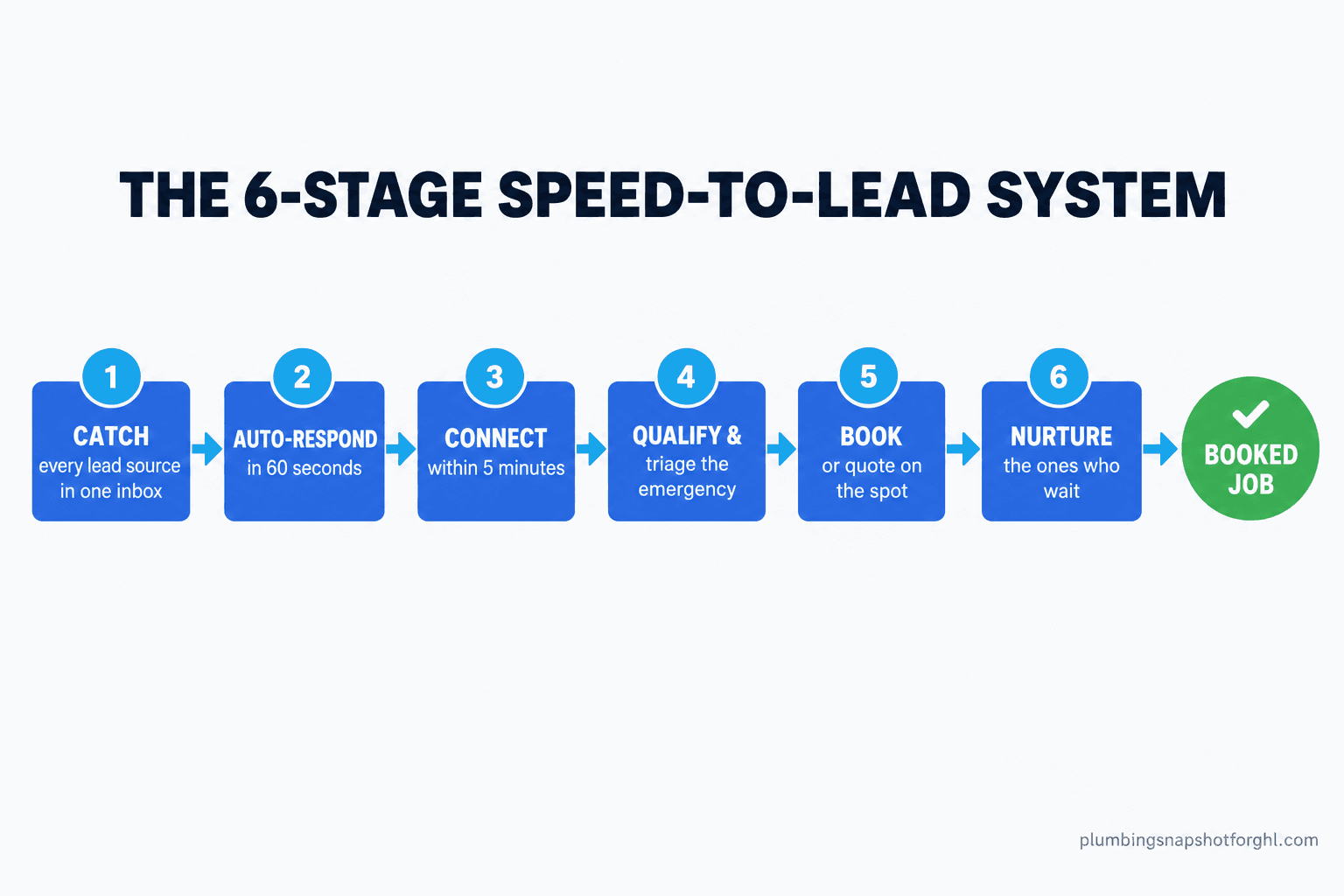
Stage 1: Catch every lead source in one place
How to set it up. Connect each source to one CRM inbox with one notification. Our CRM workflow setup wires these channels into a single pipeline so a lead cannot hide.
How it breaks. Leads scattered across five apps. If your Google messages go to one phone and your web forms to an email nobody reads, you stay fast on the channels you watch and lose the rest silently. You cannot be fast to a lead you never saw.
Stage 2: Instant auto-response in the first 60 seconds
How to set it up. For calls you cannot pick up, missed-call text-back sends an SMS within seconds: “Sorry we missed you, this is [Shop]. What is going on and what is your address?” Forms and DMs get the same instant acknowledgement. Land a message while they are still holding the phone.
How it breaks. A delay of even 20 minutes turns this into a slower voicemail. The value lives in the first minute. If your auto-text fires on a timer, you miss the window the whole system exists to catch.
Stage 3: Connect, do not just acknowledge
How to set it up. The auto-text opens the door; a quick call or reply walks through it. Ping whoever is on intake the instant a lead replies, and keep the thread in two-way SMS so a tech can answer from a job site. Speed to acknowledge buys time; speed to connect wins.
How it breaks. An auto-text with no human behind it. The homeowner replies “yes, my water heater is leaking” and hears nothing for three hours. Now you have annoyed them twice.
Stage 4: Qualify and triage the emergency
How to set it up. Ask three questions: What is the problem? What is the address? Is water flowing right now? A yes to the third routes straight to your on-call tech; a routine job goes to booking. An after-hours AI receptionist can run this triage at 2am, so a burst pipe escalates while a dripping faucet books itself.
How it breaks. Treating every lead the same. If a flooding basement waits in the same queue as a “how much for a disposal” text, you lose the high-ticket emergency and overspend on the cheap one.
Stage 5: Book or quote on the spot
How to set it up. Drop a booking link, or offer two concrete time windows. For bigger jobs, send a photo-backed quote so the number comes with context. Plenty of homeowners would rather tap an online booking link than play phone tag.
How it breaks. Ending with “we will get back to you with a quote.” That sentence is where jobs die. Book the visit or send the number while you have their attention.
Stage 6: Nurture the ones who do not book yet
How to set it up. A simple cadence of texts and emails over the next week or two keeps the quote alive. The plumbing estimate follow-up sequence lays out the timing. Speed to lead gets you into the conversation; follow-up finishes it.
How it breaks. One touch and done. “Let me talk to my spouse” is not a no, it is a not-yet, and the shop that follows up gets the call.
Steal this: the exact messages and timing
You do not need to write these from scratch. Here is the copy and cadence, ready to drop in. Keep your shop name and consent language consistent across all of them.
The instant missed-call text (fires within 60 seconds):
Hi, this is [Shop Name], sorry we missed your call! This line is
monitored by text. What's going on, and what's the service address?
We'll get a tech lined up. Reply STOP to opt out.
The web-form / DM auto-reply (fires on submission):
Thanks for reaching out to [Shop Name]! We got your request about
[issue]. Is the water actively leaking right now? If it's an
emergency, reply "NOW" and we'll call you straight away.
The emergency triage reply (when they say it’s active):
Got it, we're treating this as urgent. A tech is being notified now
and will call you within a few minutes. In the meantime, if you can,
shut off the water at the main valve. What's the best number to reach you?
The booking nudge (routine job, after qualifying):
Perfect. I can get a tech out to [address]. Here are the next two
openings: [Tue 8-10am] or [Tue 1-3pm]. Which works, or grab any slot
here: [booking link]
The follow-up cadence for an unsold quote:
Day 1 (2 hrs after quote): "Hi [Name], sent over your quote for the
[job]. Any questions I can answer? Happy to walk through it."

Day 3: "Checking in on the [job] estimate, we've still got
availability this week if you'd like to lock it in."

Day 7: "Hi [Name], your quote for [job] is good through [date]. Want
me to hold a spot before the schedule fills?"How speed to lead changes by shop size
The 5-minute rule is the same for everyone. How you hit it is not.
The solo owner-operator (1 truck)
You are the dispatcher, the tech, and the bookkeeper. You cannot answer a call from inside a wall cavity, so automation is your only shot at the 5-minute rule. Start with the two highest-impact pieces: missed-call text-back on your shop line, and an instant form auto-reply. That alone pulls you from “I call back at 10am” to “they got a text in 30 seconds.” Keep triage simple: if they say it is flooding, your phone rings; everything else books through a link. You are not building a call center, you are stopping warm leads from going to the shop down the road while your hands are full.
The growing shop (around 5 trucks)
Now you have one person on the phones, but they still miss calls during the lunch rush and the Facebook DMs pile up. The job here is coverage across channels and a clean handoff. Route every source into one inbox (Stage 1), let automation catch the overflow, and give your intake person a two-way SMS thread so they can juggle five conversations at once. A weekly missed-call report earns its keep here: pull the calls that never got a text-back, and you will usually find a repipe or two in it.
The established operation (up to 15 trucks)
At this size, speed to lead is a measured process, not a hope. Track median first-response time as a team KPI. Run after-hours coverage with an AI receptionist so the overnight burst pipe escalates to the on-call tech instead of waiting for the 7am shift. Build routing rules so emergencies, warranty calls, and quote requests each hit the right queue. The owner-operator is fighting to answer at all; the 15-truck shop is fighting to answer consistently, every lead, every hour.
The compliance layer you cannot skip
Fast texting only works if it is legal texting. The moment you automate SMS, you are in the world of the Telephone Consumer Protection Act (TCPA) and A2P 10DLC carrier registration, and getting it wrong is expensive.
The short version: you need the homeowner’s consent before automated marketing texts, clear opt-out language (“Reply STOP to opt out”), and a number registered for A2P 10DLC so carriers deliver your messages instead of filtering them. A text-back to someone who just called you is on safer footing than an unsolicited blast, because they initiated contact, but you still need the consent and opt-out mechanics in place. The FCC administers the TCPA and the rules around automated calls and texts (FCC).
Common objections, answered
“Won’t an automated text feel impersonal and annoy people?”
The opposite, in practice. A homeowner with a leak does not want a personal touch, they want a fast one. A 2026 EZ Texting survey found 69% of consumers would rather an unfamiliar business reach them by text than by phone (EZ Texting). The annoying experience is voicemail that never gets returned, not a text in 30 seconds. Keep it human and specific and it reads as attentive, not robotic.
“I already have voicemail. Isn’t that enough?”
No. Only about 37.8% of small-business calls get a live answer, and most people never leave a voicemail, they just hang up and dial the next plumber (411 Locals). Speed to lead reaches them before they move on.
“What if I already pay for ServiceTitan or another field-service platform?”
Those platforms manage work you already booked: scheduling, dispatch, invoicing. Speed to lead is the step before that, catching the inquiry in the first five minutes. If your current tool does not fire an instant text on every missed call and web form, you have a gap at the top of the funnel no back-office software fixes.
Frequently asked questions
What is speed to lead for plumbers?
Speed to lead is how fast you make real contact with a new inquiry, whether a call, web form, Google message, DM, or text. It matters because the shop that responds first almost always books the job. Research shows reaching a lead within 5 minutes instead of 30 makes you about 100 times more likely to connect and 21 times more likely to qualify it.
How fast should a plumber respond to a new lead?
Within 5 minutes, and ideally the first automated reply fires within 60 seconds. The Lead Response Management study found the odds of connecting and qualifying a lead collapse after the first five minutes. Since you cannot answer a call from inside a wall, an automated instant response is how you realistically hit that window.
Can I do speed to lead without hiring staff?
Yes. Automation handles the instant first response on every channel (missed-call text-back, form auto-replies, DM responses), so a solo owner-operator can hit the 5-minute rule without a receptionist. You step in only for the warm conversation the system hands you, or a true emergency routed to your phone.
Is automated texting legal for plumbers?
Yes, when done right. You need the customer's consent, clear opt-out language like 'Reply STOP to opt out,' and A2P 10DLC registration so carriers deliver your messages. A text-back to someone who just called you is on safer footing than an unsolicited blast, but you still need consent and opt-out in place. See our TCPA guide.
How do I measure if my speed to lead is working?
Track one number weekly: median time to first human reply across all channels. If it creeps above five minutes, you have a leak. Also pull a weekly missed-call report to see which unanswered calls never got a text-back, that list usually hides real jobs.
Speed to lead is the cheapest, highest-impact fix in a plumbing shop, because it works the leads you already paid to generate. Back to that 7:40am kitchen sink: with the system running, the homeowner who called while your hands were full got a text in 30 seconds, replied with their address, and booked the 1pm slot. Same lead, same you, same day. The only thing that changed is who answered first.
About the author
Hector Salinas is GHL Automation Lead at Plumbing Snapshot. He spent nine years dispatching for a 12-truck plumbing operation before building GoHighLevel systems full time, and he maps every call flow, on-call rotation, and speed-to-lead automation in the Plumbing Snapshot. He writes the way he would brief a new service manager: plainly, with the revenue math attached.