
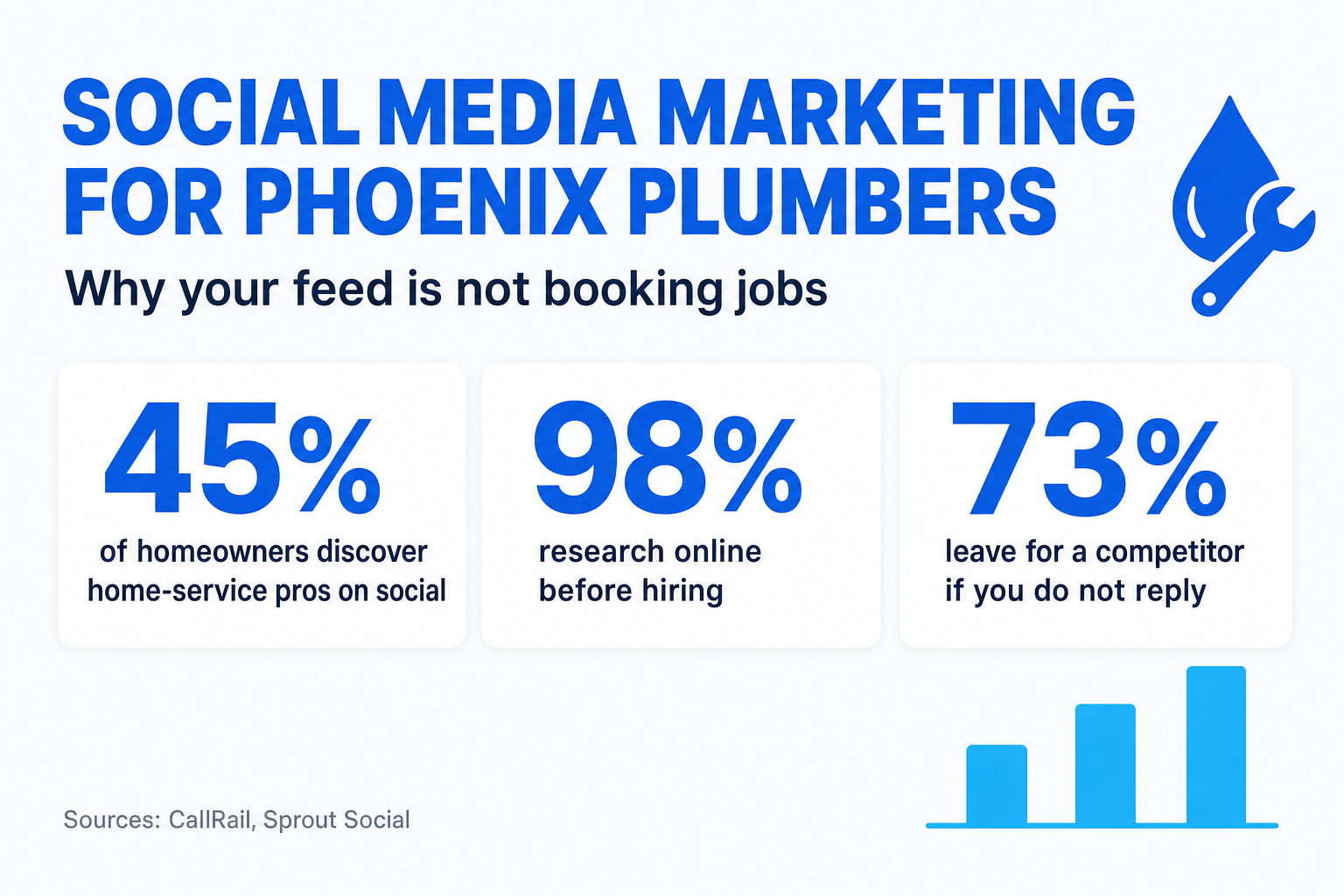
For a Phoenix plumbing shop, social media usually fails to book jobs for one reason: it’s treated as posting, not as a lead channel. A dusty grid that hasn’t moved in three weeks, zero short-form video, and DMs that sit unanswered for a day don’t lose to a competitor’s clever caption — they lose because the homeowner vetting you on Instagram or Facebook can’t find a reason to trust you, and the shop that replied in ten minutes already booked the call. That matters in a metro of roughly 4.8 million people (Point2Homes) served by more than 3,200 plumbing businesses across Arizona (IBISWorld). The homeowner with a slab leak in Ahwatukee has options — and increasingly, they narrow those options on their phone before they ever dial. This is the honest breakdown of why plumbing social media doesn’t book work, what the silence costs, and what “social that actually books jobs” looks like.
In this guide
- The short answer: why Phoenix plumbing social media doesn’t book jobs
- Why social decides who a Phoenix homeowner calls
- The 5 pain points killing your plumbing social media
- What the silence actually costs a Phoenix shop
- What “social that books jobs” looks like
- The done-for-you path
- Frequently asked questions
- About the author
- Related reading
The short answer: why Phoenix plumbing social media doesn’t book jobs
If your Instagram and Facebook aren’t producing calls, it’s almost never the content quality — it’s the system. Plumbing shops post when they remember to (which is rarely), skip video entirely, and treat comments and messages as something to check “later.” Every one of those is a leak, and they compound. A homeowner who lands on a feed that last posted in June assumes you’re out of business. A homeowner scrolling their local feed never sees you because you have no Reels for the algorithm to push. A homeowner who messages “do you do water heaters in Chandler?” and hears nothing for a day calls the next shop.
The plumbers who do get jobs from social aren’t more clever — they’re more consistent and more responsive. They show up 5 days a week, they post short video, and they reply fast. That’s a full-time discipline, and it’s the exact discipline a shop with trucks in the field can’t hold by hand. The fix isn’t “post better.” It’s to make the showing-up automatic and the replying instant — which is a done-for-you problem, not a willpower problem.
I dispatched for a Valley shop for nine years. The owners who thought social was a waste of time were right — because they were doing it wrong. An account that posts twice a quarter and ignores DMs isn’t marketing; it’s a billboard for “we’re not around.” Social books jobs when it’s consistent and it answers back. Everything else is noise.
Why social decides who a Phoenix homeowner calls
Buying a plumber isn’t a browse — it’s a panicked, high-stakes decision made in minutes. But before the call, most homeowners run a quick trust check, and social media is now part of it. 98% of consumers search online before hiring a home-services business, and 45% discover home-service providers through social media (CallRail). Zoom out and the pattern holds: 58% of consumers say they’ve discovered a new business on social media (Sprinklr), and 91% read local reviews, with a majority refusing to consider a business under four stars (BrightLocal).
Put those together and you get the modern homeowner’s research path: a “plumber near me” search, a glance at your Google profile and reviews, a peek at your Instagram or Facebook to see if you’re real and active, and — if everything lines up — a call. Miss any rung and you fall out of consideration. In Phoenix specifically, where roughly 54% of residents own their homes (Point2Homes) and aging supply lines, hard water, and summer-storm drain backups keep the phones ringing, the shops that win the emergency search are the ones that already passed the trust check.
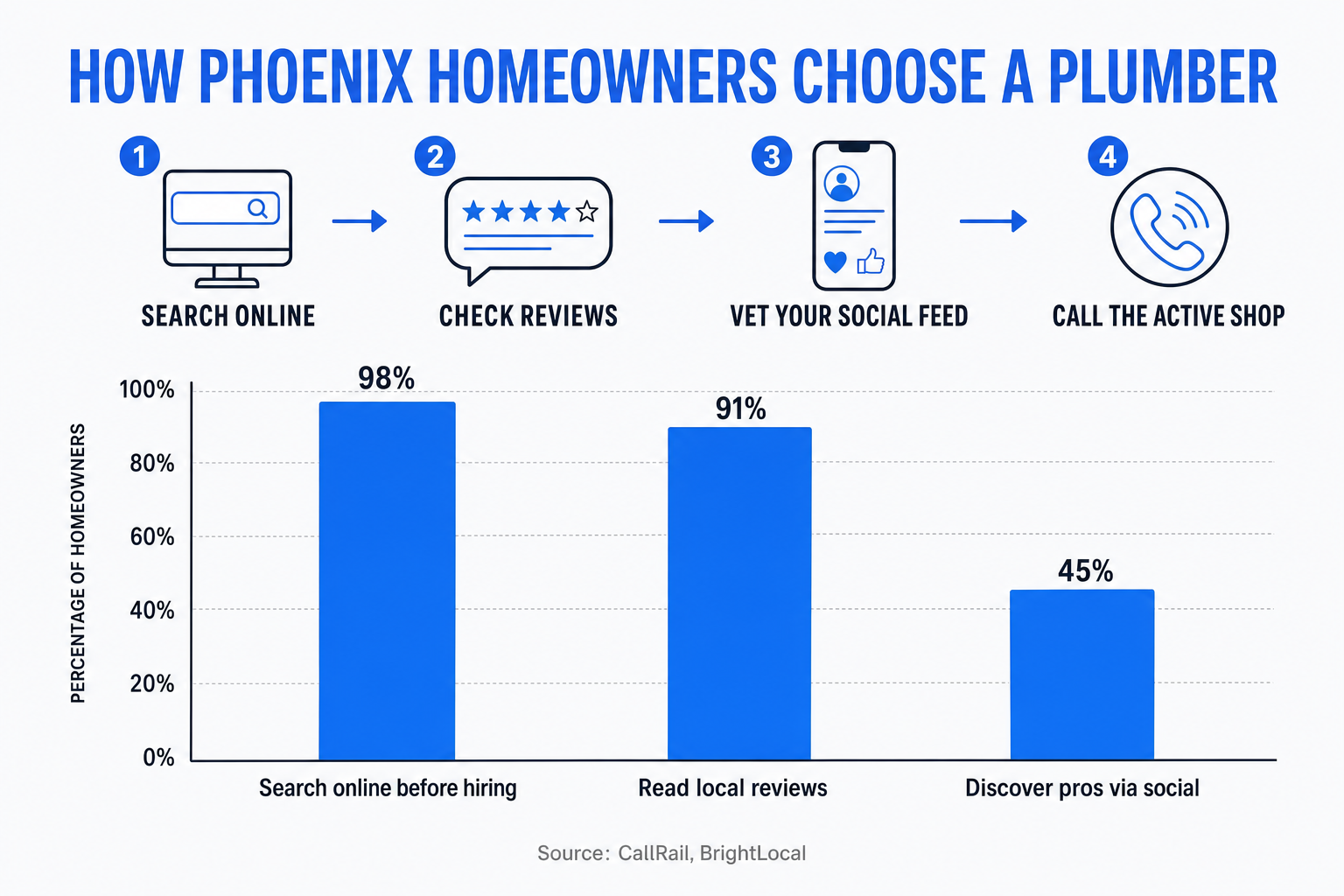
How homeowners research and choose a home-service pro. Source: CallRail — Home Services Marketing Statistics (2026) and BrightLocal — Local Consumer Review Survey.
The takeaway isn’t “social media replaces Google or local SEO” — it doesn’t. It’s that social is the trust layer that decides whether the homeowner who found you actually calls you. A strong feed converts more of the searches your other channels earn. A dead feed quietly cancels them.
The 5 pain points killing your plumbing social media
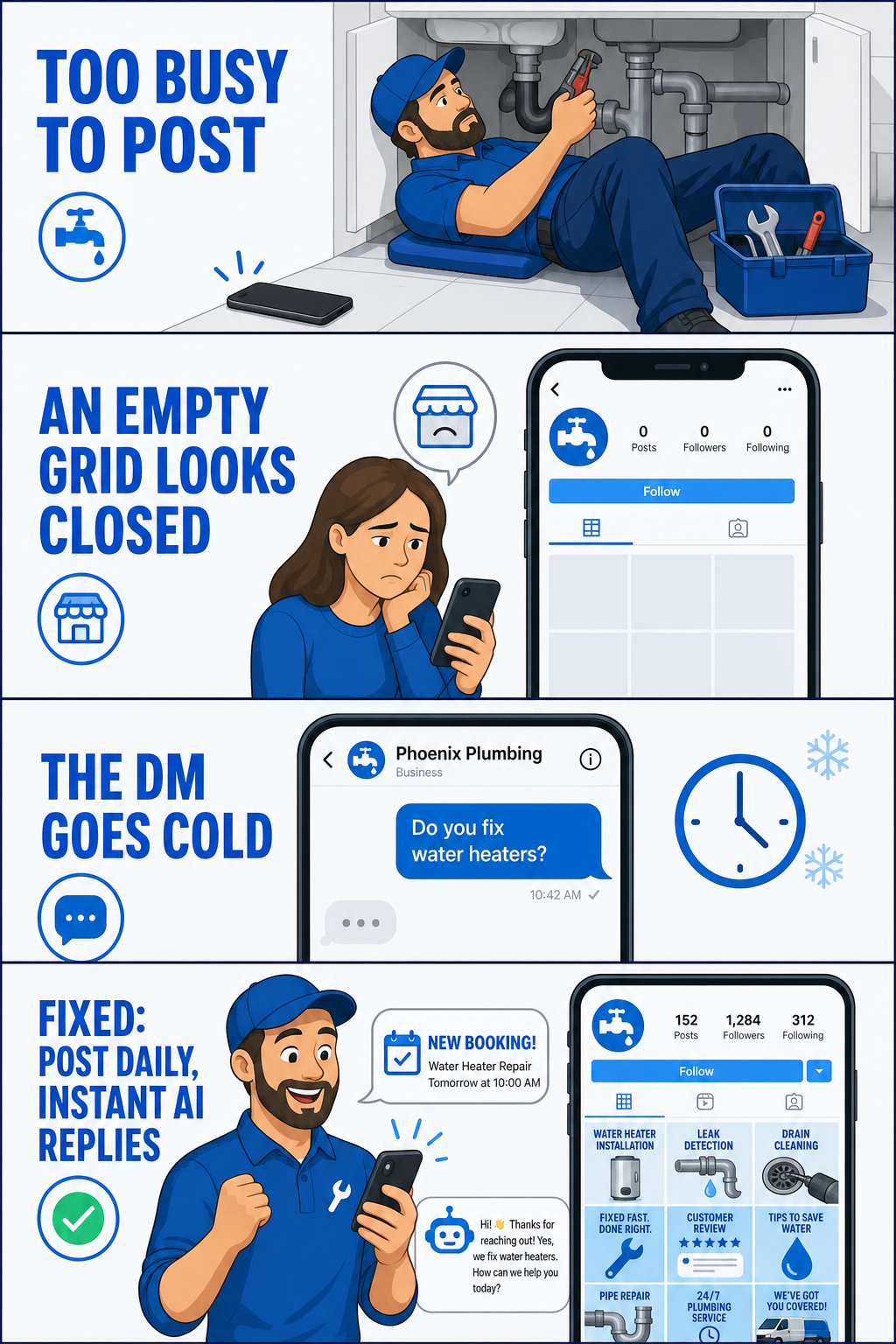
Here are the five specific failures behind almost every plumbing account that doesn’t book work. They’re not creative problems — they’re operational ones.
1. You’re under a slab, not on the app
Between service calls, dispatch, and after-hours emergencies, “post something today” never wins. Weeks pass, the feed goes quiet, and the account stalls. This is the root pain, because consistency is the one thing social media actually rewards. The algorithm favors accounts that post regularly; homeowners trust accounts that look active. An account that posts twice a quarter gets neither the reach nor the trust — it’s the marketing equivalent of a truck parked with a flat tire.
2. An empty grid reads “closed”
When a homeowner taps your profile mid-decision and sees a grid frozen three months ago, they don’t think “busy plumber.” They think “are these guys still in business?” — and they scroll to the shop that posted yesterday. Your feed is a storefront window. Because 45% of homeowners are discovering home-service pros on social in the first place (CallRail), a stale window doesn’t just fail to attract — it actively repels the customer who came to vet you.
3. No video means no reach
This is the biggest missed opportunity in the trades. Short-form video — Reels, TikToks, YouTube Shorts — is the content format the platforms push hardest to people who don’t follow you yet, which is exactly the audience a growing plumbing shop needs. Short-form video is the top-ROI content format of 2025, and 66% of consumers say it’s the most engaging type of content (HubSpot). Video also converts: 82% of consumers say they’ve been convinced to buy a product or service after watching a video (Wyzowl). A 20-second clip of a drain unclog, a tankless swap, or a burst-pipe fix is the single highest-leverage thing a Phoenix plumber can post — and almost none of them are posting it.
4. Comments and DMs go cold
Every “do you service Gilbert?” comment and every “how much for a water heater?” DM is a job trying to book — and on emergency work, the fastest reply wins. The data on patience is brutal: 73% of social users say they’ll buy from a competitor if a brand doesn’t respond (Sprout Social), 79% expect a response within 24 hours while only about half of businesses actually meet that, and 32% now expect a DM reply within an hour (Emplifi / Social Media Today). A plumber can’t watch three inboxes while crawling under a house — so the messages sit, and the jobs walk. This is the same speed-to-lead leak that missed-call text-back closes on the phone, just moved to social.
The response-time gap that loses jobs on social. Source: Emplifi Social Pulse Report 2025 (via Social Media Today) and Sprout Social Index 2025.
5. Posting to 9 apps by hand is a second shift
Facebook, Instagram, Google Business Profile, LinkedIn, TikTok, YouTube, Pinterest, Threads, Bluesky — each wants a different size, caption, and clip. Doing that by hand, 5 days a week, is a part-time job nobody in the shop has time for. So it doesn’t happen, or it happens for two weeks after a motivational YouTube video and then stops. The problem was never effort or good intentions. It’s that manual, cross-platform consistency is unsustainable for a business whose real job is fixing pipes.
What the silence actually costs a Phoenix shop
Put a number on it. Say your social accounts and Google profile send a modest 30 homeowners a month to check you out — people mid-decision, already looking for a plumber. If a stale feed and slow replies cause even a third of them to choose someone else, that’s 10 lost prospects a month. In a market where a single water-heater install runs $1,800–$3,000 and a repipe or sewer job runs five figures, recovering just one of those lost prospects a month can outweigh a year of doing social media right.
The cost isn’t only the jobs you lose today. It’s the compounding trust you never build: the reviews you don’t harvest, the referrals that never see you in the feed, the neighborhood familiarity that makes you the obvious call next time. Silence on social is a slow leak — invisible month to month, expensive over a year.
Sources: CallRail, Wyzowl, Sprout Social, Emplifi.
What “social that books jobs” looks like
Flip every pain point into its fix and you get a clear picture of what working plumbing social media actually is:
- Consistent publishing, 5 days a week, so your feed always looks active and the algorithm keeps showing you. In practice that’s a steady rhythm of a homeowner-question post, a branded tip graphic, swipeable carousels (“5 warning signs of a slab leak,” “tank vs. tankless”), and — critically — a short vertical Reel.
- Short-form video every week, because that’s what reaches Phoenix homeowners who don’t follow you yet. A drain unclog, a tankless swap, a freeze-warning tip filmed on the truck. You only need one to break out to change your month.
- Instant replies to comments and DMs, so no “do you service my area?” ever goes cold. This is where AI earns its keep: an AI comment agent and DM agent reply in your shop’s voice within seconds, qualify the homeowner, collect name, number, address, and issue, and book the job straight onto your calendar — 24/7.
- A web chat agent that does the same for anonymous website visitors, turning traffic into booked calls via an AI chat widget.
- All 9 channels covered from one brand voice, cropped and captioned correctly for each — without you touching nine apps.
- The content feeding the rest of your machine, so posts drive reviews and reviews feed the next homeowner’s trust check. Social, reputation, and lead generation stop being separate chores and start reinforcing each other.
The shops that win social in the Valley aren’t the ones with the biggest personalities. They’re the ones that show up every week and answer every message in minutes. Make those two things automatic and social stops being a time sink and starts being a lead source — like a second truck that only ever generates jobs.
The done-for-you path
Here’s the honest math on doing this yourself versus having it done. To run plumbing social right, you’d need a content designer, a video editor, a social manager, and someone answering messages around the clock — a combination that runs $4,000–$8,000 a month if you hire it. Or you do it yourself, badly, until you quit. Neither works for a shop that should be running trucks.
That’s exactly the gap our done-for-you social media service fills. For $397/month per brand — no setup fee, 100% white-label, cancel with 15 days’ notice — you get a full content engine (a weekly text/Q&A post, an image post, two carousels, and a short Reel, published 5 days a week) across all 9 channels, plus three AI agents that handle comments, DMs, and website chat and book qualified homeowners straight onto your calendar. Every lead and appointment lands in a CRM you can log into anytime. It’s the whole social-and-response system — the consistency and the instant replies — running without a second of your day.
Frequently asked questions
Does social media actually book jobs for plumbers?
Yes — but as a trust-and-response layer, not a standalone lead machine. 45% of customers discover home-service providers through social media and 98% research online before hiring (CallRail), and most homeowners glance at your Instagram or Facebook to confirm you're real and active before they call. A consistent feed with short video plus fast replies to comments and DMs converts more of the searches your other channels earn. A stale, silent feed quietly cancels them. So social books jobs when it's consistent and responsive, and wastes time when it's neither.
How often should a Phoenix plumbing shop post on social media?
Aim for a consistent cadence of about 5 posting days a week, with a mix of formats and at least one short video (Reel) weekly. Consistency matters more than volume: the algorithm rewards regular posting with reach, and homeowners trust accounts that look active. An account that posts twice a quarter gets neither. That steady rhythm is hard to hold by hand while running trucks, which is why most shops either automate it or let it lapse.
Why does short-form video matter so much for plumbers?
Because it's the content platforms push hardest to people who don't already follow you — exactly the new homeowners a growing shop needs. Short-form video is the top-ROI content format of 2025, 66% of consumers call it the most engaging content type (HubSpot), and 82% say they've been convinced to buy after watching a video (Wyzowl). A 20-second drain unclog, tankless swap, or freeze-warning clip is the single highest-leverage post a Phoenix plumber can make — and it's the one most shops skip entirely.
How fast do I need to reply to comments and DMs?
Faster than you think. 73% of social users will buy from a competitor if a business doesn't respond (Sprout Social), 79% expect a reply within 24 hours, and 32% expect a DM answer within an hour (Emplifi). On emergency plumbing work, the fastest reply usually wins the call. Since a plumber can't watch three inboxes from under a house, AI comment and DM agents that reply in seconds, qualify the homeowner, and book the job are the practical way to close that gap 24/7.
How much does done-for-you plumbing social media cost?
Our done-for-you social media service is $397/month per brand with no setup fee, 100% white-label, and cancellation with 15 days' notice. That includes a weekly content engine (a text/Q&A post, an image post, two carousels, and a short Reel, published 5 days a week) across all 9 channels, plus three AI agents that handle comments, DMs, and website chat and book qualified homeowners onto your calendar. Running up to 4 brands is $997/month — useful for multiple locations or agencies reselling to plumbing clients. For comparison, hiring a designer, editor, social manager, and community manager separately runs $4,000-$8,000 a month.
Do I keep ownership of my social accounts and leads?
Yes. You stay the owner of every social account — you connect the accounts you already have (or create them) during onboarding, and that connection is all that's needed to publish on your behalf. Every lead and every appointment the AI agents book lands in a CRM under your own login, with the homeowner's name, phone, address, and full conversation, so you can see everything at any time and are never locked out.
About the author
Hector Salinas is the GHL Automation Lead for Plumbing Snapshot for GHL, based in Phoenix, AZ. He spent nine years dispatching for a 12-truck Valley plumbing operation before he ever touched a CRM, and learned the hard way that a business is only as strong as the calls it doesn’t miss. He now maps the after-hours call flows, speed-to-lead automations, and social response systems inside the Plumbing Snapshot, and writes the way he’d brief a new service manager: plainly, with the revenue math attached.
Related reading
- Missed-Call Text-Back for Plumbers — the same speed-to-lead fix, applied to the phone.
- Local SEO for Plumbers: Rank in the Google Map Pack — the search channel your active feed reinforces.
- Double Your Google Reviews in 60 Days — turn social engagement into 5-star reviews.
- How to Get More Plumbing Leads — where social fits in the full lead machine.
- Done-For-You Social Media for Plumbers — the content engine and AI agents behind everything above.