
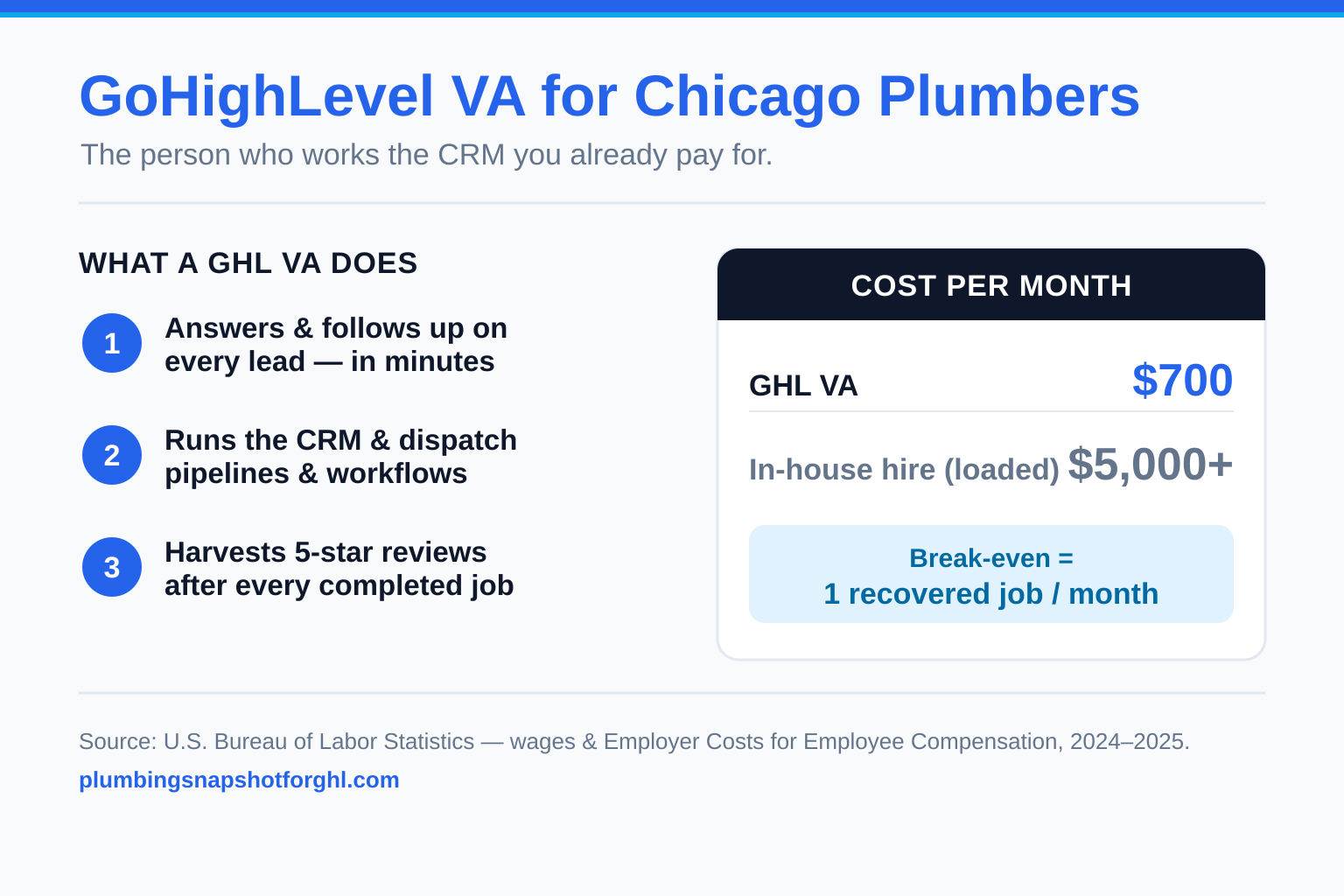
A GoHighLevel VA is a trained virtual assistant who runs your GHL account for you — answering and following up on every lead, keeping the CRM and dispatch pipelines clean, sending review requests, and building the funnels and workflows you don’t have time to touch after a 10-hour day on the trucks. For a Chicago plumbing shop, the point is simple: the software only makes money if someone works it, and a $700-a-month VA works it full-time for a fraction of what a fully loaded in-house coordinator costs — roughly $5,000+ a month once you add payroll taxes and benefits. In a metro this size, where hard water, freeze-thaw burst pipes, and aging cast-iron sewer laterals keep the phones ringing, the gap between “GHL is installed” and “GHL is worked every day” is the gap between leads that book and leads that call the next plumber on the map.
In this guide
- The short answer: what a GoHighLevel VA does for a Chicago plumbing business
- What a GoHighLevel VA actually does, day to day
- The real cost of running GoHighLevel yourself
- GHL VA vs in-house hire vs DIY: the cost compared
- The ROI math: what one recovered job covers
- Why this matters more in Chicago
- How to hand off GoHighLevel without losing control
- Frequently asked questions
- About the author
- Related reading
The short answer: what a GoHighLevel VA does for a Chicago plumbing business
GoHighLevel is a powerful platform, but it is not a set-and-forget machine. Somebody has to answer the leads it captures, work the pipeline stages, send the review requests, fix the funnel that broke, and register the A2P campaign so your texts actually deliver. On most plumbing shops, that “somebody” is the owner — doing it in the truck between calls and at the kitchen table after dinner. That is exactly the work that slips, and slipped follow-up is lost revenue.
A GoHighLevel VA is a trained assistant who takes that job off your plate. They live inside your GHL sub-account and run it like an operations manager: monitoring inbound leads and replying within minutes, keeping the dispatch and estimate pipelines current, building and repairing automations, chasing unsigned estimates, requesting reviews after every completed job, and reporting what booked. You keep ownership and oversight; they do the daily grind. For a Chicago shop that would otherwise let the CRM go stale, that is the difference between software you pay for and software that pays you back.
The number one reason a plumbing shop’s GoHighLevel account underperforms isn’t the build — it’s that nobody works it. The owner is on a water heater at 2 PM and answering leads at 10 PM, if at all. A VA closes that gap. Their whole job is to make sure no lead sits, no estimate goes cold, and no happy customer leaves without being asked for a review.
What a GoHighLevel VA actually does, day to day
Think of a GHL VA as the person who does everything the automation can’t finish on its own. A typical week covers:
- Speed-to-lead follow-up. Every form fill, missed-call text-back, web-chat, and Google Local Services lead gets a fast human-quality reply — inside minutes, not hours — and gets worked until it books or is disqualified.
- CRM & pipeline hygiene. Contacts tagged, opportunities moved through stages (New → Quoted → Scheduled → Won), stale leads re-engaged, duplicates merged. A clean pipeline is what makes your numbers trustworthy.
- Dispatch & scheduling support. Confirming appointments, sending reminders to cut no-shows, and routing emergency requests to the on-call tech through your workflows.
- Estimate follow-up. Chasing every unsigned quote on a cadence — the single highest-ROI task most shops skip. (See plumbing estimate follow-up.)
- Review harvesting. Firing the review request after each completed job and monitoring responses, so your Google profile keeps climbing — and it matters, because 89% of consumers read how a business replies to reviews (BrightLocal). (See how a review pipeline doubles output.)
- Build & maintenance. Creating funnels, calendars, and workflows; fixing broken automations; and handling the unglamorous setup like A2P/10DLC registration so your SMS stays compliant and deliverable.
- Reporting. A weekly readout of leads in, calls answered, jobs booked, and review count — so you can see the system working.
The real cost of running GoHighLevel yourself
The DIY path looks free — you already pay for GHL — but the true cost shows up as leaked jobs and the owner’s own time. Two numbers frame it.
First, speed. The Lead Response Management research found that contacting a web lead within five minutes makes you dramatically more likely to reach and qualify it — the odds of qualifying a lead drop roughly 21× when you wait 30 minutes instead of 5 (MIT / InsideSales via Harvard Business Review). No owner running trucks can hit a 5-minute window by hand. The lead sits, and a plumbing lead that sits is a plumbing lead that called someone else.
Second, missed calls. About 27% of calls to home-services businesses go unanswered, and each one costs roughly $1,200 in lost revenue — before you count the customer’s lifetime value (Invoca). Emergency plumbing work runs far above that average. The automation can text back a missed call, but someone has to work that conversation to a booking. That someone is your VA.
The third cost is the one owners feel but rarely price: their own hours. The evenings spent building a funnel, the mornings lost chasing quotes, the reviews never requested. That is skilled operator time — worth far more on a job than on data entry — being spent on work a $20/hr VA is built to do.
GHL VA vs in-house hire vs DIY: the cost compared
The instinct, once a shop grows, is to hire an office person. But look at the fully loaded cost. The BLS puts the median base wage for general office and administrative support at $46,320, and for a marketing coordinator (market-research analyst) at $76,950 (U.S. Bureau of Labor Statistics). Benefits and payroll taxes then add on top: the BLS Employer Costs survey shows benefits make up nearly 30% of total employer compensation, which means the loaded cost of a hire is about 1.4× base pay (BLS Employer Costs for Employee Compensation). That works out to roughly $5,500–$9,000 a month for one seat that still needs weeks of training on GoHighLevel — a platform most new hires have never seen.
A GHL VA already knows the platform and comes in around $700/month for a dedicated block of hours, or $20/hr pay-as-you-go with no contract for one-off builds. Same core work; a fraction of the cost and none of the hiring risk.
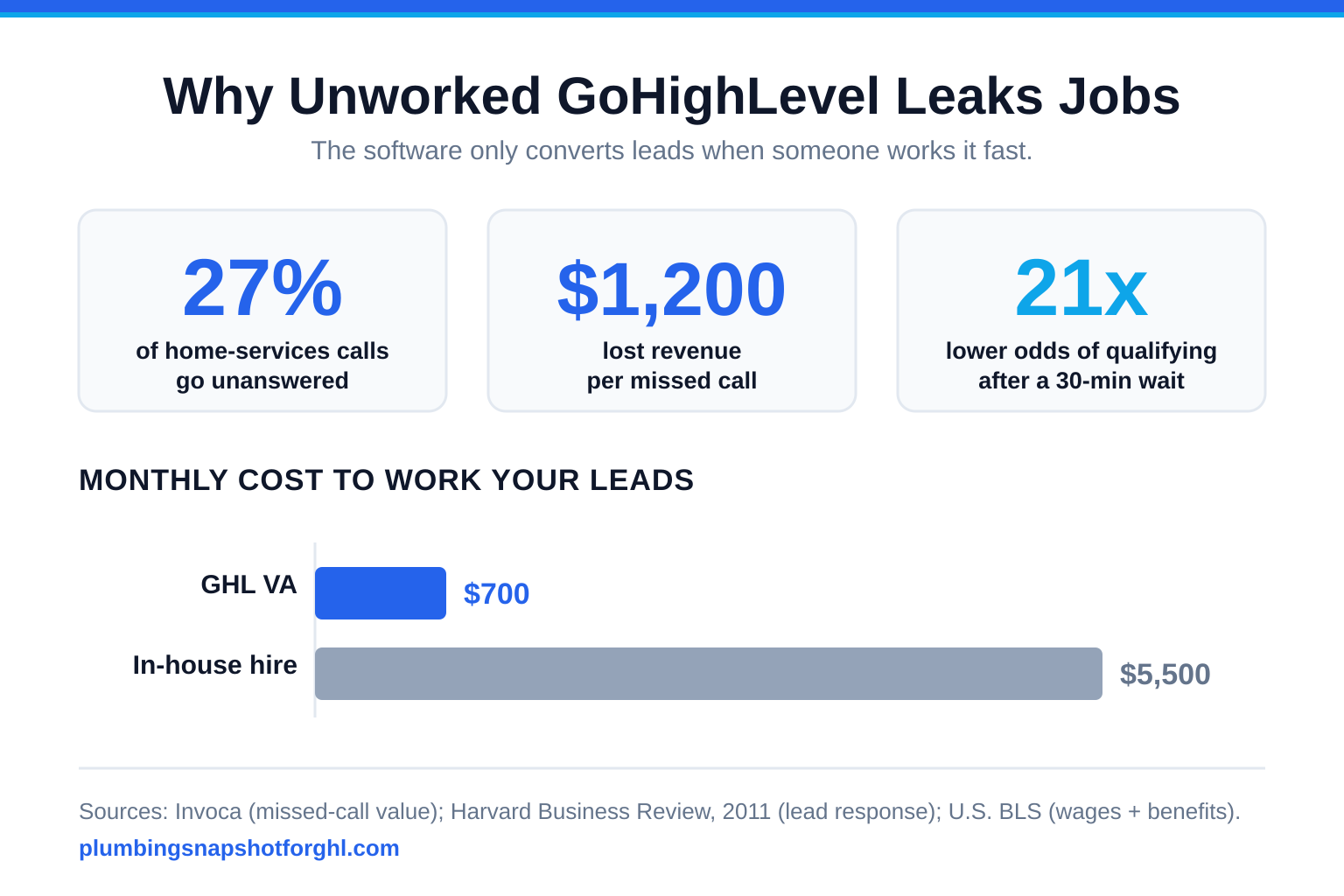
Monthly cost to actually work your GHL leads, by staffing model. In-house figure = BLS median admin/coordinator base pay plus ~40% benefits & payroll overhead. Sources: U.S. Bureau of Labor Statistics — wages, Employer Costs for Employee Compensation, and Invoca; VA pricing per Plumbing Snapshot VA plans.
The ROI math: what one recovered job covers
This is where the decision gets easy. A GHL VA at ~$700/month has to “pay for itself,” so ask: how many extra jobs does it take to cover $700?
For most plumbing shops, the answer is one. A single recovered emergency call — a burst-pipe callout, a water-heater swap, a sewer backup — clears the monthly cost by itself, and often several times over. Everything the VA books beyond that first job is margin you weren’t capturing before.
Illustrative: a single recovered job typically dwarfs the monthly VA cost. Ticket ranges reflect common U.S. residential plumbing pricing. Source: Housecall Pro — How to Price Plumbing Jobs (2026).
Now layer in what the VA does repeatedly: every estimate chased instead of forgotten, every missed call worked to a booking, every completed job turned into a review that wins the next customer. Faster response alone reliably lifts conversion, and consistent estimate follow-up recovers jobs that would otherwise die in the inbox. The VA doesn’t book one job a month — that’s just the break-even. It books the steady stream your installed-but-unworked GHL account is currently leaking.
Why this matters more in Chicago
Chicago is a hard market to run a plumbing shop in — and a great one to automate. The Chicago–Naperville–Elgin metro is home to roughly 9.6 million people and about 3.7 million households, around two-thirds of them owner-occupied (U.S. Census — Chicago metro profile) — which means a homeowner with a flooded basement has a long list of plumbers to call and no patience for the one who doesn’t pick up. Illinois has nearly 5,000 plumbing businesses competing for that work (IBISWorld — Plumbers in Illinois), so standing out is about responsiveness as much as skill.
The city’s building stock makes the demand relentless. Chicago’s aging housing and legacy cast-iron and clay sewer lines drive constant drain and sewer work, and its brutal freeze-thaw winters make burst pipes a seasonal certainty — the classic 2 AM emergency that books with whoever answers. When the temperature swings and a hundred pipes let go across the North Side in one night, the shop that converts that surge is the one with someone (or something) answering and following up every single lead. A GHL VA is how a small shop competes with the big franchises’ call centers without hiring one.
How to hand off GoHighLevel without losing control
Handing over your CRM feels risky. It isn’t, if you scope it right. A clean handoff looks like this:
- Grant scoped sub-account access. Your VA works inside your GHL sub-account with the permissions they need — not your billing, not your bank. You stay the owner.
- Agree the daily checklist. Define exactly what “worked” means: leads answered within X minutes, pipeline updated daily, estimates chased on a set cadence, reviews requested after every job.
- Set the guardrails. Approved reply scripts, your pricing rules, and a clear escalation path for anything unusual. Compliance (TCPA/A2P opt-in) is handled to the letter — see TCPA for plumbers.
- Review the weekly report. Leads in, calls answered, jobs booked, reviews added. Numbers keep everyone honest and show the ROI in black and white.
If you’d rather not manage even that, the alternative is a done-for-you system: our Plumbing Snapshot installs the workflows, and a dedicated GHL VA runs them — so you get the output without becoming a CRM administrator. Either way, the goal is the same: your GoHighLevel account should be working every lead, every day, whether or not you have the time to log in.
What is a GoHighLevel VA?
A GoHighLevel VA is a virtual assistant trained specifically on the GoHighLevel platform who runs your account for you. For a plumbing shop that means answering and following up on leads within minutes, keeping the CRM and dispatch pipelines clean, chasing unsigned estimates, requesting reviews after each job, building and fixing funnels and workflows, and handling setup like A2P/10DLC SMS registration. You keep ownership and oversight; the VA does the daily work that otherwise falls to the owner at night.
How much does a GoHighLevel VA cost for a plumbing business?
A dedicated GHL VA runs about $700/month for a set block of hours, or $20/hour pay-as-you-go with no contract for one-off builds like a funnel or A2P registration. Compare that to a full-time in-house coordinator: BLS median base pay is $46,320 for general admin and $76,950 for a marketing coordinator, and with payroll taxes and benefits (about 30% of total compensation) the loaded cost is roughly 1.4× that — about $5,500–$9,000 a month. The VA already knows GoHighLevel, so there's no training ramp.
Is a GHL VA worth it for a small Chicago plumbing shop?
For most shops, yes — the break-even is about one recovered job a month. A single burst-pipe callout, water-heater swap, or sewer job typically covers the ~$700 monthly cost several times over. Because about 27% of home-services calls go unanswered (each worth roughly $1,200) and the odds of qualifying a lead drop sharply after just a few minutes, a VA working every lead fast tends to recover far more than one job — the rest is margin your unworked GHL account is currently leaking.
Will a VA have access to my bank account or billing?
No. A properly scoped GHL VA works inside your GoHighLevel sub-account with only the permissions they need to run leads, pipelines, workflows, and reviews. They do not touch your billing or bank. You remain the account owner, approve the big decisions, and review a weekly report of leads, calls, jobs booked, and reviews added.
What's the difference between a GHL VA and the AI receptionist in the snapshot?
They work together. The AI receptionist and automations handle the instant, 24/7 layer — answering after-hours calls, texting back missed calls, and booking simple appointments automatically. The VA is the human operations layer on top: working the conversations the AI starts, handling judgment calls, keeping pipelines and estimates moving, building new funnels, and reporting results. The snapshot is the machine; the VA is the person who runs it.
Do I need to already use GoHighLevel to hire a VA?
It helps, but no. If you're already on GoHighLevel, the VA steps into your existing sub-account. If you're not, we can deploy the Plumbing Snapshot first — the done-for-you GHL system for plumbing contractors — and then have the VA run it. Either way you end up with a working system and a person operating it, rather than software you pay for and never touch.
About the author
Yvonne Castellanos is the Snapshot Strategist and Agency Partner Success lead for Plumbing Snapshot for GHL, based in Charlotte, NC. She runs partner success for agencies that resell the Plumbing Snapshot to local shops and has onboarded contractors from solo owner-operators to regional outfits running recurring maintenance memberships. Her focus is the boring money — review pipelines, estimate follow-up, and the retention automations that keep a plumbing brand booked between emergencies — and she writes case-grounded playbooks for owners who need a system to prove its ROI inside the first 30 days.
Related reading
- GoHighLevel for Plumbers — the full automation system a VA operates day to day.
- Missed-Call Text-Back for Plumbers — catch the calls you miss, then have a VA work them to a booking.
- Plumbing Estimate Follow-Up — the highest-ROI task most shops skip, and the one a VA never does.
- Plumbing Answering Service vs AI Receptionist — the 24/7 layer that pairs with a VA.
- Hire a Dedicated GHL VA — trained GoHighLevel operators from $700/month, no contract.