
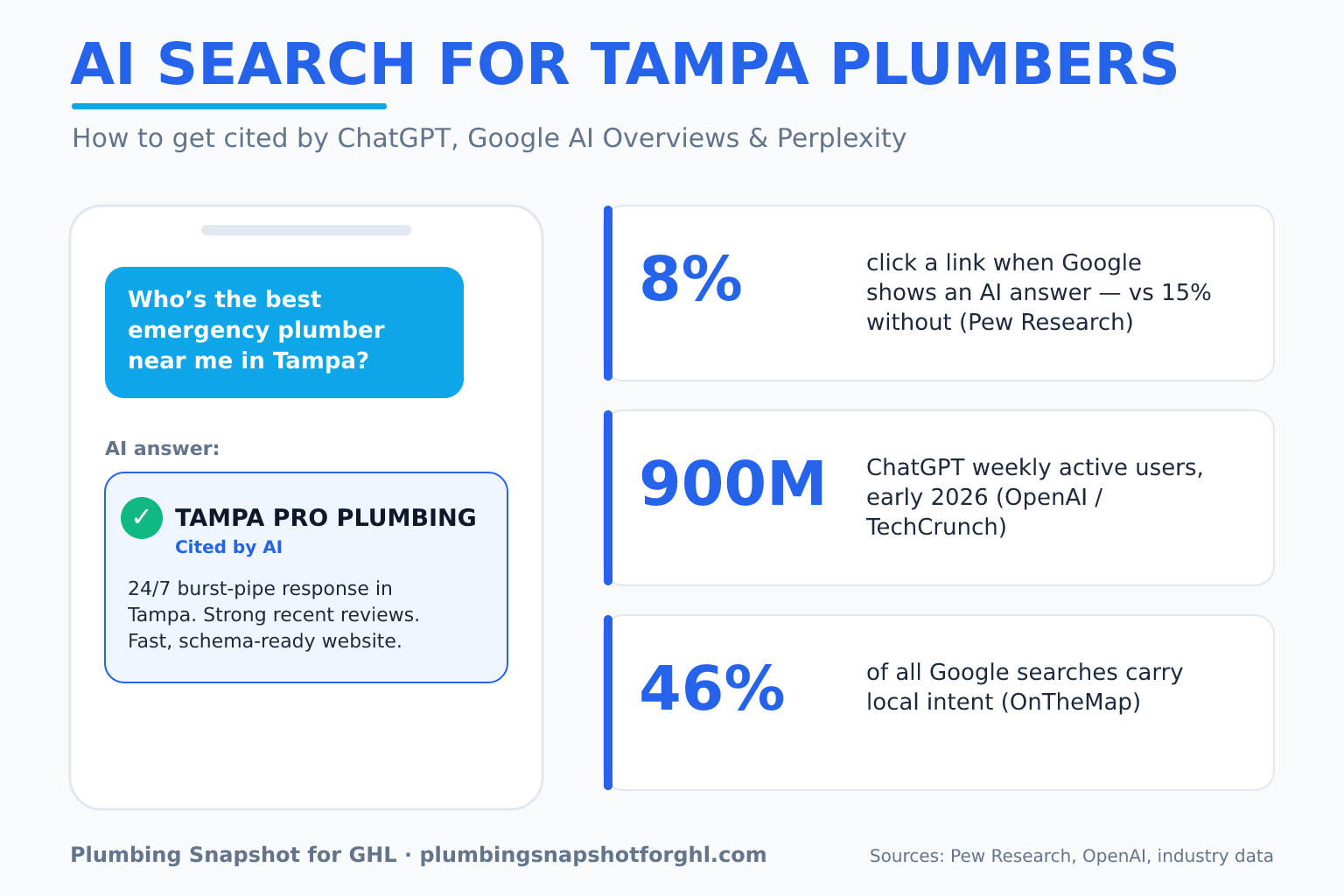
A Tampa homeowner with water spreading across the kitchen floor no longer just Googles “emergency plumber near me” and scrolls a list of blue links. Increasingly, they ask an AI — Google’s AI Overview, ChatGPT, or Perplexity — “who fixes a burst pipe fast in Tampa?” and act on the two or three businesses it names. Getting your shop into that short, spoken-style answer is a discipline called GEO (Generative Engine Optimization), and it is not the same as old-school SEO. It rewards a fast website, clean structured data, an llms.txt file AI crawlers can read, real Tampa location pages, and answer-first content. Do it and you become one of the handful of plumbers an AI recommends by name. Skip it and you’re invisible in the exact moment a panicked homeowner is choosing who to call.
In this guide
- What “AI search” actually means for a Tampa plumbing business
- The data: how fast AI search took over
- Why this hits home-services plumbers hard
- The 5-step GEO playbook to get your Tampa shop cited by AI
- What it looks like when it works
- Mistakes that keep Tampa plumbers invisible to AI
- Frequently asked questions
- About the author
- Related reading
What “AI search” actually means for a Tampa plumbing business
“AI search” is the shorthand for the new front door to your business: the AI-generated answers that now sit above the traditional results. Three surfaces matter for a plumber:
- Google AI Overviews — the AI summary box at the top of a Google results page that answers the question directly and cites a few sources.
- AI assistants — ChatGPT, Perplexity, Gemini, and Copilot, where people increasingly ask for a recommendation the same way they’d ask a neighbor.
- Voice and phone assistants that read one answer aloud — no list, no scrolling.
The optimization work that gets you into those answers goes by two names you’ll see used interchangeably: AEO (Answer Engine Optimization) and GEO (Generative Engine Optimization). The goal is the same — be the business the machine names when a homeowner asks it who to call. That’s a different target than ranking blue-link #1, and it needs a different setup.
Old SEO was a race to the top of a list. AI search is a race to be in the paragraph. There’s no page two — there’s the answer, and everything the answer left out. For an emergency trade like plumbing, being left out of that paragraph is the whole ballgame.
The data: how fast AI search took over
This isn’t a someday trend. AI answers moved from novelty to default in about a year, and the numbers show it.
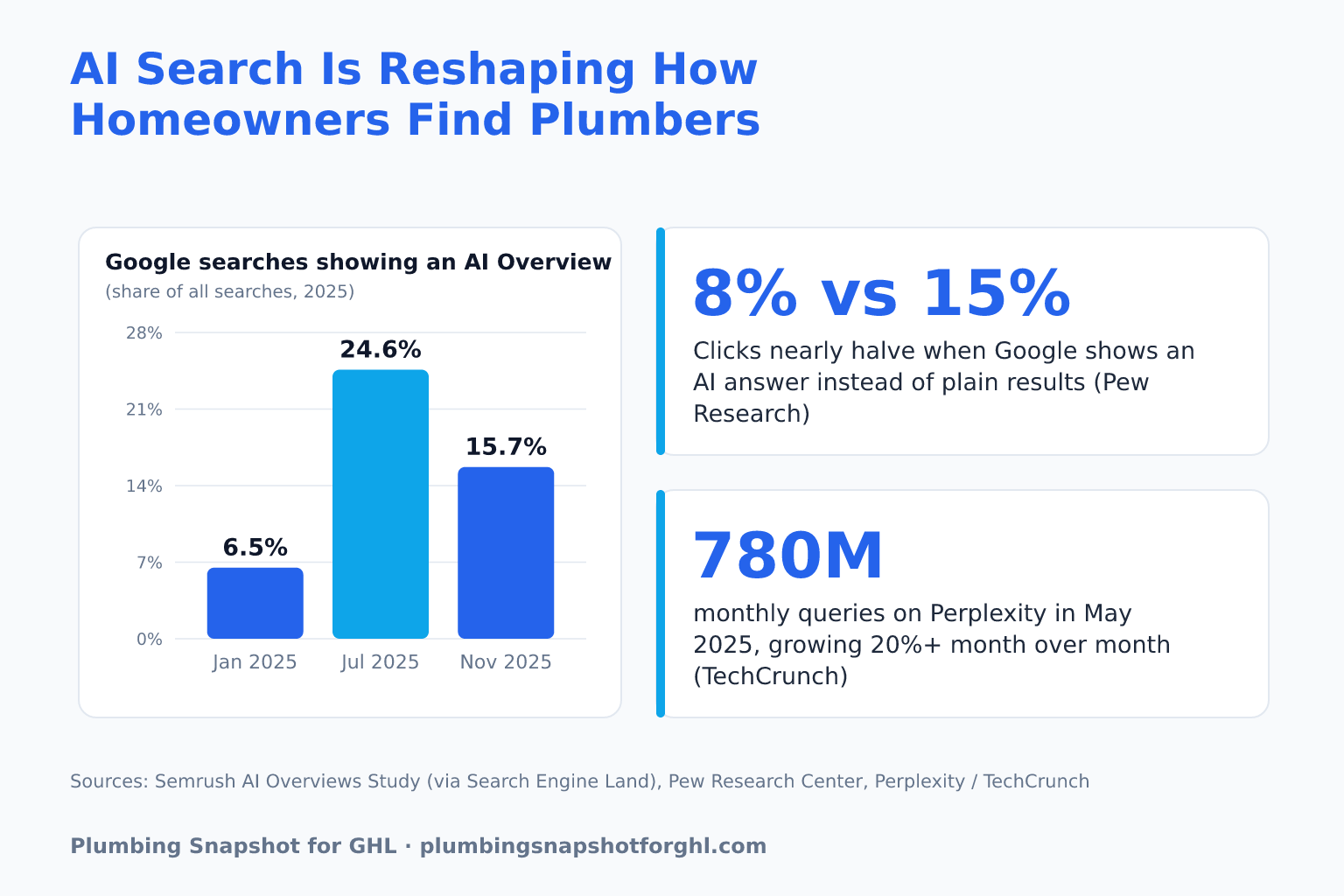
Google AI Overviews scaled fast. Semrush’s study of 10 million keywords found AI Overviews appeared in 6.49% of searches in January 2025, surged to a 24.61% peak in July, and settled around 15.69% by November 2025 — while spreading from purely informational queries into commercial and transactional ones (the informational share of AI Overview queries fell from 91.3% in January to 57.1% by October) (Semrush AI Overviews Study, via Search Engine Land).
Percentage of Google searches showing an AI Overview across 2025 — a sharp surge, then a partial pullback, as coverage broadened beyond informational queries. Source: Semrush AI Overviews Study (via Search Engine Land).
The AI answer keeps the click. The most important data point for any local business came from the Pew Research Center, which tracked 68,879 real Google searches in March 2025. When an AI summary appeared, users clicked through to a website just 8% of the time — versus 15% when there was no summary — and they clicked a link inside the AI summary only 1% of the time (Pew Research Center). Translation: if the AI answer doesn’t name you, you may never get the visit at all.
The assistants are now genuinely big. ChatGPT is nearing 900 million weekly users (TechCrunch) and fields roughly 2.5 billion prompts a day (TechCrunch). Perplexity reported 780 million queries in a single month (May 2025), growing more than 20% month over month (TechCrunch). A slice of those are people asking, in plain words, for a local service pro.
Why this hits home-services plumbers hard
Plumbing is the near-perfect storm for AI search, for three reasons.
First, the intent is local and urgent. About 46% of Google searches have local intent, and the vast majority of local-mobile searches lead to a call or visit within 24 hours (OnTheMap). A homeowner with a slab leak in South Tampa isn’t researching for a week — they want a name, a number, and a “they can come today.” That’s exactly the kind of decisive, high-value query AI assistants are being used for.
Second, the answer is short — so the shortlist is short. A traditional Map Pack shows three businesses; a page-one list shows ten. An AI answer often names two or three, sometimes one. The math of being cited is brutal: with clicks collapsing to single digits when an AI answer shows (Pew), the businesses inside that answer capture the attention and everyone else fights over scraps.
Third — and this is the honest nuance — local queries still lean on Google’s Map Pack and reviews, not only on AI Overviews. AI Overviews fire less often on explicitly local “near me” searches than on informational ones, so your Google Business Profile, review volume, and local pages remain essential (Semrush AI SEO statistics). The good news: the same foundations — structured data, fast pages, real location content, and steady reviews — feed both the Map Pack and the AI answer. You are not choosing between them; you’re building the base that wins both.
The 5-step GEO playbook to get your Tampa shop cited by AI
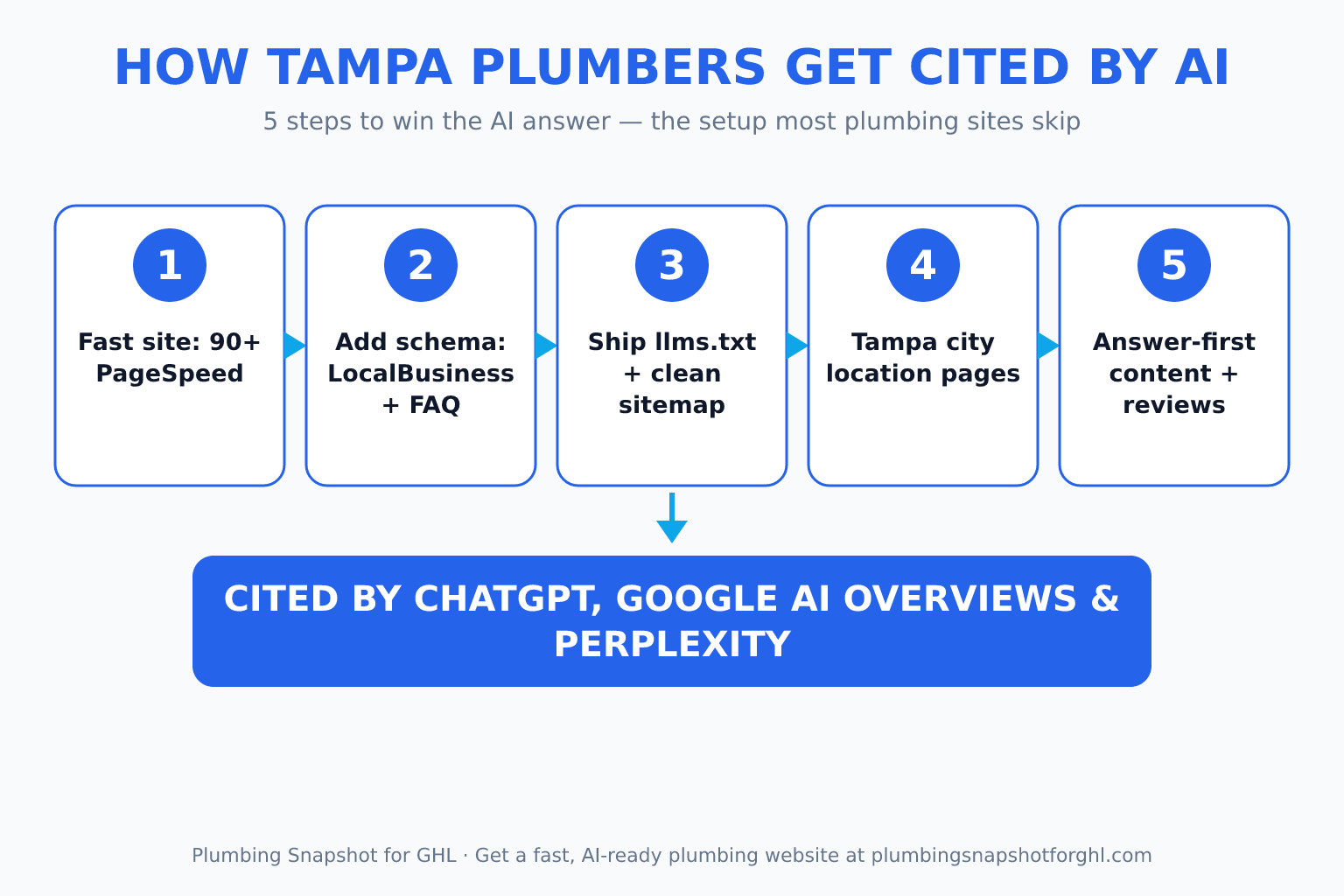
Here is the practical part. These five moves are what actually get a plumbing business surfaced and cited by AI engines. Most Tampa plumbing sites do none of them — which is exactly why the opening is there.
Step 1 — Make the site fast enough to be crawled and cited
AI crawlers and Google both favor pages that load fast and render cleanly. A bloated WordPress or page-builder site — heavy plugins, slow scripts, shifting layout — is hard to parse and slow to index, which quietly caps your visibility. Modern static-first frameworks like Astro ship almost no JavaScript and serve from a global edge, hitting a 90+ Google PageSpeed score. Fast pages are the price of admission: an engine that can’t quickly read your content won’t cite it.
Step 2 — Add structured data (schema) so machines understand you
Schema markup is the labeled, machine-readable version of your page — it tells an AI engine “this is a plumbing business, here’s the service area, the phone, the hours, the services, the FAQ answers.” At minimum, ship LocalBusiness (or Plumber) schema, Service schema, and FAQPage schema on the relevant pages. This is the single most direct way to make your content quotable, because it hands the engine clean facts instead of making it guess from your layout.
Step 3 — Ship an llms.txt and a clean sitemap
llms.txt is a simple text file at the root of your site that gives AI crawlers a curated map of your most important pages and content — the AI-era equivalent of a sitemap written for language models. Pair it with a correct sitemap.xml and robots.txt that welcomes the AI crawlers, and you make it trivial for an engine to find, read, and index the pages you want cited. Very few plumbing sites ship this today.
Step 4 — Build real Tampa location pages
An AI engine recommending a plumber “in Tampa” needs unambiguous, on-page proof that you serve Tampa — and ideally the specific neighborhoods (South Tampa, Brandon, Riverview, Carrollwood). Thin, one-line “areas we serve” footers don’t cut it. Dedicated location pages with local detail — service area, response times, common local issues (Florida’s hard water, slab leaks, aging cast-iron laterals) — give both Google and the AI a concrete reason to name you for a Tampa query.
Step 5 — Write answer-first content and keep reviews flowing
AI engines lift self-contained, question-shaped passages: a clear question as a heading, then a direct 2–3 sentence answer. Structure your service and FAQ pages that way (“How fast can a plumber reach South Tampa for a burst pipe?” → a real answer). Then keep the reviews coming — review volume and recency are trust signals both the Map Pack and AI answers weigh heavily. An automated review pipeline that asks after every completed job is how a small shop out-signals a franchise.
What it looks like when it works
Picture two Tampa shops the night a cold front cracks a cluster of pipes. A homeowner grabs their phone and asks their assistant, “Who can fix a burst pipe near me in Tampa right now?”
Shop A runs a five-year-old WordPress site: slow to load, no schema, one generic “service areas” line, no llms.txt, a dozen old reviews. The AI has little clean data to work with, so it doesn’t name them — it names the two shops it can parse and trust.
Shop B runs a fast, schema-rich site with a real “Emergency Plumbing in Tampa” page, an FAQ answering that exact question in two sentences, an llms.txt pointing crawlers to it, and a steady stream of fresh reviews. The assistant reads it cleanly and answers: “For an emergency in Tampa, Shop B offers 24/7 burst-pipe response and has strong recent reviews.”
Same storm, same homeowner, same neighborhood. One shop is in the answer; the other is invisible at the exact second the decision gets made. With clicks to non-cited results collapsing when an AI answer appears (Pew), that gap is the whole job.
The Tampa metro is home to roughly 3 million people (Macrotrends) — a deep, growing market of homeowners who are, right now, learning to ask an AI who to call. The shops that set up for it early own the answer before the competition realizes the answer exists.
Mistakes that keep Tampa plumbers invisible to AI
The through-line: every one of these is a website and systems problem, not a marketing-budget problem. You don’t out-spend your way into an AI answer — you out-structure it. That’s a one-time setup that keeps paying, which is exactly why we bundle all five steps into our done-for-you plumbing website build and the pre-wired snapshot that keeps reviews and follow-up flowing on autopilot.
What is GEO (Generative Engine Optimization) for plumbers?
GEO is the practice of structuring your website and content so AI answer engines — Google AI Overviews, ChatGPT, Perplexity, and Gemini — name your plumbing business when someone asks them for a recommendation. It overlaps with traditional SEO but targets a different result: being cited inside the AI's answer rather than ranking as a blue link. The core moves are a fast site, structured data (schema), an llms.txt file, real location pages, and answer-first content plus steady reviews.
How do I get my Tampa plumbing business to show up in ChatGPT and Google AI Overviews?
Give the engines clean, fast, well-labeled content to read. In practice: (1) run a fast site that loads in under a couple of seconds and hits a 90+ PageSpeed score; (2) add LocalBusiness, Service, and FAQPage schema; (3) publish an llms.txt file and a correct sitemap/robots that welcome AI crawlers; (4) build dedicated Tampa (and neighborhood) location pages; and (5) write answer-first content — a clear question heading followed by a direct 2–3 sentence answer — while keeping fresh reviews coming. Those signals feed both the AI answer and Google's Map Pack.
Is AI search actually replacing Google for finding a local plumber?
It's changing it, not replacing it overnight. Google AI Overviews appeared in roughly 6.5% of searches in January 2025, peaked near 24.6% in July, and settled around 15.7% by November (Semrush). For explicitly local 'near me' searches, the Map Pack and reviews still do most of the work, so local SEO remains essential. But ChatGPT (nearing 900 million weekly users) and Perplexity (780 million queries in a single month) are now large enough that a share of homeowners ask an assistant directly — and that share is growing.
Do I need a new website to rank in AI search, or can I fix my current one?
You can improve most sites, but there's a ceiling. If your current site is a slow, plugin-heavy WordPress or page-builder site, you can add schema and an llms.txt and get some lift. The bigger gains — the 90+ PageSpeed, clean rendering, and proper location-page structure that AI engines reward — are much easier to hit on a modern static-first build. If your site loads slowly or you're billed by the hour for every edit, a rebuild usually pays for itself in visibility and saved fees.
How is GEO different from the local SEO I'm already doing?
They share a foundation and differ at the finish. Local SEO aims to rank you in Google's Map Pack and organic results; GEO aims to get you named inside AI-generated answers. The underlying signals overlap heavily — schema, fast pages, real location content, and reviews help both. GEO adds a few AI-specific pieces (llms.txt, answer-first passage structure, and content written to be quoted). Think of GEO as local SEO extended for the answer-engine era, not a separate program.
How long until my plumbing site shows up in AI answers?
There's no guaranteed day-one result, and anyone promising instant AI citations isn't being honest. Once the technical foundations are in place — fast pages, schema, llms.txt, location pages, answer-first content — engines typically need to crawl and re-index over a period of weeks to a few months, and citation frequency builds as your review and content signals strengthen. The businesses that start now are simply in the answer sooner than the ones still waiting.
About the author
Tyler Brennan is the Compliance & Conversion Editor for Plumbing Snapshot for GHL, based in Columbus, OH. He started in field-service marketing writing Google Ads for drain and sewer specialists, then moved into the technical side of getting service businesses found and converting — from SMS and consent compliance to the on-page structure that wins search. He pressure-tests every workflow against both the rules and the homeowner’s patience, and writes checklists a busy plumbing operator can actually follow.
Related reading
- Astro vs WordPress for Plumber Websites — why site speed and structure decide whether you get found.
- Local SEO for Plumbers — rank in the Google Map Pack, the foundation GEO builds on.
- GoHighLevel for Plumbers — the automation system behind the reviews and follow-up AI engines trust.
- Double Your Google Reviews in 60 Days — the review signal that wins both the Map Pack and the AI answer.
- Get a Plumbing Website — a fast, schema-ready, AEO/GEO-built site, live in 10 working days.